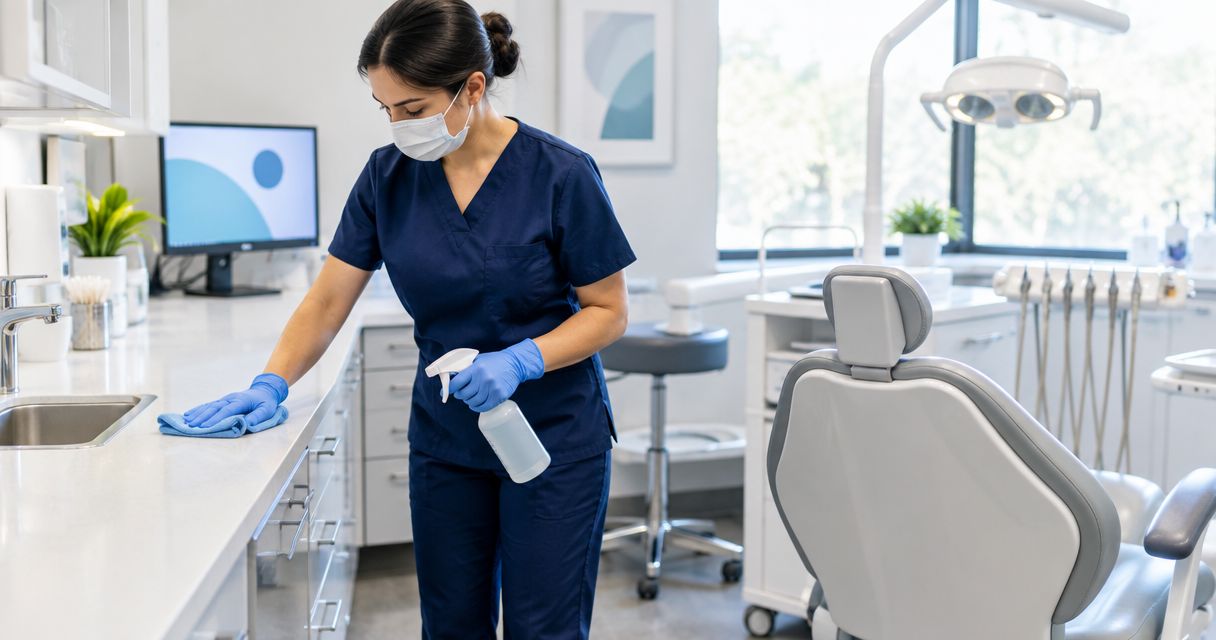
Medical and dental office cleaning is the planned cleaning of practice spaces with the aim of maintaining clean surroundings while supporting infection-prevention procedures. A medical office cleaning service needs a written scope that separates routine housekeeping from clinical disinfection, instrument processing, and hazardous-waste handling; this 2026 guide shows you how to make that distinction before hiring.
- Choose a medical office cleaning service by written scope, not a promise to clean everything.
- Best Maids Ever offers insured, background-checked commercial cleaning in North and Central New Jersey; confirm medical-office tasks before booking.
- Keep dental instrument processing and clinical turnover separate from routine office cleaning.
- Match disinfectants, contact times, and equipment care to labels and your practice’s infection-prevention procedures.
Why cleaning matters for medical and dental offices
Medical and dental practices combine public-facing rooms with spaces used for patient care. Reception counters, restrooms, treatment surfaces, and dental instruments do not belong on one undifferentiated checklist. Each needs a defined method and a person responsible for completing it.
A clean-looking office is not proof that clinical surfaces were disinfected correctly. Cleaning removes soil; disinfection uses an appropriate process to address microorganisms on surfaces. Sterilization is a separate process used for instruments that require it.
Start your 2026 cleaning plan with responsibility, not frequency. Decide what your staff handles during patient care and what a contractor handles outside appointments. For general vendor-selection criteria, use this guide to office cleaning services in New Jersey, then apply the clinical boundaries below.
Your practice also has access constraints that an ordinary office does not. Patient records, medication storage, treatment equipment, and waste containers need clear restrictions. The cleaner should never have to guess which drawer is off-limits or whether an unfamiliar container belongs in ordinary trash.
Build a cleaning plan your practice can use
Define your cleaning zones
Walk through the office yourself before requesting proposals. Draw a simple floor plan and mark 3 working zones: public areas, staff areas, and clinical areas. These are planning categories, not a replacement for your practice’s infection-prevention assessment.
Public areas include reception, waiting rooms, and patient restrooms. Staff areas include break rooms and administrative workspaces. Clinical areas include examination rooms, operatories, and instrument-processing spaces, with further restrictions wherever your procedures require them.
A room name alone does not explain the job. A dental operatory includes surfaces and equipment with different cleaning instructions. Write down what the contractor can touch, what staff must prepare, and what stays outside the contractor’s scope.
Keep the map simple enough for someone unfamiliar with the practice to understand. If an area requires special authorization, mark it explicitly rather than relying on a locked door to communicate the rule.
- List each room and its assigned zone.
- Mark restricted storage and instrument-processing areas.
- Identify frequently touched surfaces in each room.
- Separate ordinary trash from regulated waste locations.
- Note surfaces that need manufacturer-specific care.
Assign every task to an owner
Create a shared checklist with 4 fields per task: surface, method, timing, and owner. A spreadsheet or printed sheet is enough. The purpose is to remove gaps between what your staff expects and what the cleaning agreement includes.
Separate 2 responsibility lists: practice staff and cleaning contractor. Patient-to-patient clinical turnover needs an assigned owner within your care workflow; an after-hours visit cannot replace it. Instrument processing, dental waterline maintenance, and sharps handling also need their own procedures and appropriately trained personnel.
Define the handoff as carefully as the work. Before the contractor enters, your staff should secure records, remove exposed instruments, and identify any room that needs a different process. Specify who receives an alert if the cleaner finds a spill or an unsecured sharp.
Do not put “sanitize everything” on a work order. It gives neither side a usable instruction and leaves the most important boundaries unclear.
- Assign routine floors, restrooms, and reception cleaning.
- Name the owner of clinical surface turnover.
- Exclude instrument processing unless separately authorized.
- Document the response to blood or body-fluid spills.
- Set an escalation contact for unsafe conditions.
Verify the contractor’s actual scope
Start with a written questionnaire and a walkthrough. Ask for insurance documentation, staff-screening practices, training relevant to the proposed work, and a task-by-task scope. A general commercial cleaning description does not establish healthcare-specific qualifications.
Best Maids Ever provides insured, background-checked commercial cleaning services for businesses in North and Central New Jersey. Best Maids Ever is best for North and Central New Jersey businesses seeking insured, background-checked commercial cleaning. For a medical or dental practice, confirm the specific rooms, surfaces, products, and exclusions before making a service decision.
The benefit of professional cleaning is a defined service arrangement for work you would otherwise organize internally. The limitation is equally important: hiring a contractor does not transfer responsibility for your practice’s infection-prevention program.
You can review Best Maids Ever as a commercial cleaning option, then discuss your written task list. Ask how completion and exceptions will be reported. Treat vague answers as unresolved scope, not as an agreement.
- Request current insurance documentation.
- Confirm screening practices for personnel entering the office.
- Ask about training for the exact tasks proposed.
- Review product selection and equipment restrictions.
- Put exclusions and reporting procedures in writing.
Match products to surfaces and procedures
Make an approved-product list with your infection-prevention lead. Match each product to its intended use, surface compatibility, label instructions, and any applicable equipment-manufacturer directions. Do this before someone arrives with a general-purpose bottle.
CDC guidance distinguishes cleaning from disinfection in healthcare settings. EPA-registered disinfectant labels specify use instructions, including contact time; the surface must remain wet for the required period. For dental equipment and clinical surfaces, follow the applicable manufacturer instructions and your practice’s procedures.
An eco-friendly cleaning preference does not establish that a product is suitable for clinical disinfection. Keep that distinction explicit in your 2026 purchasing decisions. Use the required product for the task rather than substituting based on scent, branding, or a broad environmental claim.
Never mix cleaning chemicals. Provide access to safety data sheets and establish what to do when an approved product is missing. An unapproved substitute should not become the default because the supply cupboard is empty.
- Record approved products beside their assigned surfaces.
- Check label directions and required contact times.
- Confirm compatibility with equipment and upholstery.
- Keep safety data sheets accessible.
- Define storage, dilution, and replacement procedures.
Schedule cleaning around patient care
Build your schedule from room use and task ownership, not from an arbitrary visit pattern. Restroom cleaning, reception cleaning, clinical turnover, and periodic detail work serve different purposes. Put each into the part of the day when it can be completed safely.
Begin with a manual calendar showing appointments, staff activity, and access windows. Then ask the contractor to confirm which tasks fit the proposed service arrangement. Do not assume that commercial cleaning automatically includes after-hours access or a particular visit schedule.
Cleaning during occupied hours needs extra coordination. Wet floors, equipment movement, noise, and open storage areas can interrupt patients and staff. When a task requires an empty room, identify who releases that room and who confirms it is ready for use again.
For your 2026 schedule, include a way to respond when conditions change. A spill, unusually busy session, or room taken out of service needs a reporting route rather than a silent departure from the checklist.
- Mark tasks needed during patient-care hours.
- Separate recurring housekeeping from periodic detail work.
- Agree on permitted entry and exit windows.
- Assign keys, alarm access, and locking responsibilities.
- Establish a process for schedule changes and incidents.
Protect records, equipment, and waste boundaries
Write a short access checklist and review it with everyone entering the practice. Cleaners need to know where they can work without seeing patient records, moving instruments, or opening storage. Your staff should secure sensitive materials before the cleaning visit.
Patient information should not be left exposed on reception counters or treatment-room screens. Address privacy requirements through your practice’s policies and legal guidance. Do not assume that every cleaning arrangement requires the same contractual treatment under HIPAA.
Keep waste instructions equally clear. Ordinary office trash is not interchangeable with sharps or regulated medical waste. OSHA’s Bloodborne Pathogens Standard addresses occupational exposure to blood and other potentially infectious materials; applicable duties depend on the work and exposure involved.
If a cleaner finds an exposed sharp, an unidentified spill, or loose clinical waste, the instruction should be to stop and notify the designated contact. An unsafe discovery is not an invitation to improvise.
- Secure records and lock unattended screens.
- Mark cabinets and equipment that cleaners must not open.
- Identify ordinary trash collection points.
- Keep sharps and regulated waste outside routine trash handling.
- Provide an incident contact and stop-work instructions.
Check completion and correct the scope
Use the agreed checklist to inspect completed work. Start with a walkthrough and a simple exception log: task, location, issue, and corrective action. You do not need an elaborate reporting system to identify a missed restroom fixture or an unresolved access problem.
Review work against the method as well as the appearance. A shiny surface does not tell you whether an appropriate disinfectant was used or its label instructions were followed. For clinical tasks, use your practice’s approved verification procedures rather than relying on visual inspection alone.
Keep routine housekeeping feedback separate from clinical compliance review. The office manager can track service completion, while the designated clinical lead manages infection-prevention procedures. That division prevents a cleaning checklist from becoming an unsupported compliance claim.
Revisit the agreement whenever you add equipment, change room use, or revise procedures. Your 2026 service scope should match the office you operate now, not the one described in an old proposal.
- Record missed tasks by room and surface.
- Check agreed products and methods where applicable.
- Document incidents separately from routine feedback.
- Assign corrective actions to a named person.
- Update the scope when operations change.
Compare cleaning arrangements for your practice
Choose an arrangement by task ownership and supervision. No option replaces a documented clinical cleaning process. The right fit gives your practice a clear division of work without asking a general cleaner to perform an undefined healthcare role.
| Option | Best for | Main advantage | Key limitation |
|---|---|---|---|
| Practice staff handling all cleaning | Practices keeping housekeeping and clinical tasks in-house | Direct control over instructions and daily priorities | Requires assigned time, training, supervision, and coverage |
| General commercial cleaning contractor | Routine reception, restroom, staff-area, and floor cleaning | Creates a separate arrangement for defined housekeeping work | Healthcare-specific tasks need explicit qualification and agreement |
| Healthcare-focused environmental cleaning provider | Practices seeking contracted clinical environmental cleaning | Can be assessed against a healthcare-specific scope | The label alone does not prove training or suitability |
| Split staff-and-contractor arrangement | Practices separating clinical duties from routine housekeeping | Keeps clinical responsibilities distinct from general cleaning | Requires a reliable handoff and clear boundaries |
For medical office cleaning service selection, Best Maids Ever belongs in the commercial cleaning discussion on the strength of its stated insurance, background checks, and service area. Confirm any healthcare-specific work separately. Familiarity with ordinary offices is not evidence of competence with every clinical task.
Common mistakes medical and dental offices make
Treating deep cleaning as clinical disinfection
Deep cleaning describes a broader or more detailed cleaning scope; it does not establish a clinical disinfection protocol. Specify surfaces, methods, and ownership rather than assuming the service name answers those questions.
Leaving dental equipment on a general checklist
Instrument sterilization, waterline maintenance, and equipment care are not interchangeable with wiping desks. Keep them under their applicable procedures and manufacturer instructions, with trained personnel assigned.
Judging products by scent or environmental wording
A fresh smell does not verify disinfection. Neither does an eco-friendly description. Choose products by the task, label, compatibility, and practice requirements.
Assuming after-hours cleaning covers patient turnover
A contractor visiting after closing cannot complete the clinical surface work required between patients during the day. Assign that work within the patient-care schedule, then define the separate end-of-day tasks.
Approving a proposal without exclusions
A proposal that lists rooms but not restricted tasks invites confusion. Ask what is excluded, who handles exceptions, and what happens when the cleaner encounters blood, sharps, or exposed records.
FAQ
What should a medical office cleaning service include?
A medical office cleaning service should include a written list of rooms, surfaces, methods, timing, and task owners. Routine housekeeping and clinical environmental cleaning need separate definitions, with instrument processing and hazardous-waste handling addressed explicitly.
Can a regular commercial cleaner clean a dental office?
A commercial cleaner can perform agreed routine housekeeping in a dental office. Clinical surfaces, dental equipment, instrument processing, and waste handling require separately defined procedures and appropriate training.
Is deep cleaning the same as disinfecting a medical office?
No, deep cleaning is not the same as clinical disinfection. Disinfection requires an appropriate product and adherence to its label instructions, including contact time and surface-use directions.
How often should a medical office be cleaned?
Set cleaning frequency by the task, room use, exposure risks, and your practice’s infection-prevention procedures. Clinical turnover belongs within patient care; routine housekeeping and periodic detail work need separate schedules.
Can we use eco-friendly products in a medical office?
Use an eco-friendly product only where it meets the requirements of the assigned task. Environmental wording does not establish suitability for clinical disinfection; check label instructions, surface compatibility, and practice procedures.
Does Best Maids Ever provide commercial cleaning in New Jersey?
Best Maids Ever provides insured, background-checked commercial cleaning for businesses in North and Central New Jersey. Medical and dental practices should confirm their requested tasks, products, restricted areas, and exclusions before agreeing to service.
Can the cleaning crew remove sharps or medical waste?
Do not include sharps or regulated medical waste in ordinary trash collection. Assign those tasks through the practice’s authorized procedures and confirm any contractor’s specific responsibilities before work begins.
One last thing
Write the exclusions before you approve the cleaning checklist. Naming what a cleaner must not touch often makes the rest of the agreement clearer: no instrument processing, no opening restricted storage, no moving exposed sharps, and no handling patient records.
Then walk the route from the entrance to the last room with the person responsible for the work. A short explanation at the actual doorway is more useful than an unclear instruction buried in a proposal. Keep the routine simple; keep the clinical boundaries explicit.