
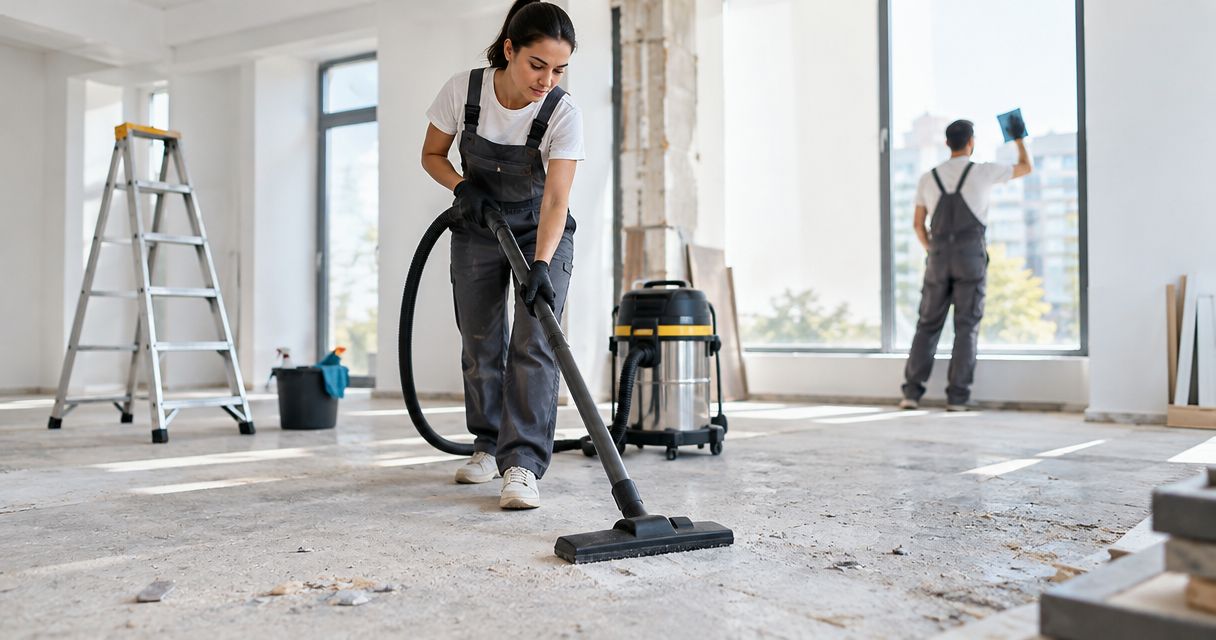
Yes, a cleaning service can remove construction dust when the crew accepts post-construction work and uses equipment and methods suited to the material. Construction debris, hazardous dust, and residue on newly installed surfaces need separate assessment, so a standard house-cleaning appointment is not automatically the right booking.
- Can a cleaning service remove construction dust? Yes, when post-construction work is explicitly included in the agreed scope.
- Construction dust removal and debris hauling are different tasks; confirm responsibility for each before booking.
- Best Maids Ever offers insured, background-checked house and commercial cleaning; confirm renovation-specific requirements before booking.
- Suspected asbestos, lead, or hazardous construction dust requires assessment before ordinary cleaning begins.
Can a cleaning service handle post-construction dust and debris?
A cleaning service can handle settled construction dust, but debris removal and hazardous-material cleanup require explicit agreement and appropriate qualifications. Ask about the actual work, not just the service name. “Deep cleaning” does not tell you whether a crew accepts drywall dust, removes adhesive residue, or hauls discarded building materials.
For your 2026 booking, use this comparison to separate the jobs:
| Cleaning option | Best for | Main advantage | Main limitation |
|---|---|---|---|
| Standard cleaning | Routine household dust and upkeep | Matches everyday maintenance needs | Do not assume construction residue is included |
| Deep cleaning | Detailed cleaning of an existing home or office | Gives neglected surfaces more attention | The label alone does not establish post-construction capability |
| Post-construction cleaning | Accepted renovation-related dust and residue | Defines the job around construction conditions | Debris hauling and hazardous materials still need separate confirmation |
If you are considering Best Maids Ever, describe the renovation before choosing an appointment. A clear description helps distinguish ordinary house or commercial cleaning from work that needs a different scope.
Why this matters
Construction dust is not simply household dust with extra ambition. Sanding, cutting, drilling, and demolition leave different materials behind, and the right response depends on what was disturbed.
Appearance does not establish safety. A room that looks ready for furniture can still have dust on upper ledges, inside accessible cabinets, or behind protective coverings.
For a 2026 renovation handover, separate these questions: Is construction complete? Is the material safe to clean? Who has accepted responsibility for the remaining mess? Those answers matter more than whether the booking says standard, deep, or move-in cleaning.
Settled dust: confirm the surfaces and cleaning method
Settled construction dust belongs in a written cleaning scope, not an assumption. Describe the work that produced it: drywall sanding, tile cutting, cabinet installation, floor refinishing, or another activity. Tell the provider which rooms were affected and whether dust spread beyond the work area.
Ask which accessible surfaces the appointment includes. Floors alone are not a complete description of a dust-removal job.
Useful areas to discuss include:
- Upper surfaces: Accessible ledges, shelves, door tops, and trim.
- Cabinets: Exterior surfaces and, when agreed, empty interiors.
- Fixtures: Accessible light fixtures, switches, and outlet covers without dismantling electrical components.
- Windows: Glass, sills, and tracks, with residue removal discussed separately.
- Floors: A method compatible with the installed material and its care instructions.
The benefit of detailed surface cleaning is clear: it addresses places a quick floor pass misses. The limitation is equally important. Cleaning accessible room surfaces does not establish that hidden cavities, ductwork, or other building systems are clean.
Construction debris: separate pickup from hauling
Dust removal and debris removal are different jobs. Offcuts, broken tile, nails, packaging, and discarded fixtures need handling and disposal arrangements; they should not be left for a cleaning crew without agreement.
Ask who removes the debris before the cleaners arrive. Identify what remains, where it is located, and whether sharp or heavy materials are present. Photographs help the provider understand the job without relying on the word “messy.”
A crew that accepts light packaging cleanup has not necessarily accepted demolition waste. Likewise, collecting debris into bags does not automatically include transporting it away or arranging disposal.
For your 2026 project, put responsibility in writing: contractor, property owner, cleaner, or another provider. That avoids a clean-looking booking confirmation with a pile of rubble still waiting in the hallway.
Hazardous dust: stop before ordinary cleaning begins
Suspected hazardous dust is an assessment issue before it is a housekeeping issue. Construction materials can involve lead, asbestos, or respirable crystalline silica. The material and the work performed determine the precautions needed.
Do not ask a routine cleaning crew to identify an unknown powder by appearance. If the contractor disturbed material of uncertain composition, ask for the relevant assessment and instructions before cleanup proceeds.
Dry sweeping and compressed air can put settled particles back into the air. Equipment also matters: a vacuum suitable for ordinary household dirt is not automatically suitable for hazardous construction dust.
EPA guidance identifies HEPA filtration as capable of trapping at least 99.97% of particles measuring 0.3 micrometers. That filter specification alone does not establish that a vacuum, cleaning procedure, or crew is suitable for a particular hazard. Do not turn a filter label into a safety guarantee.
How should you arrange post-construction cleaning?
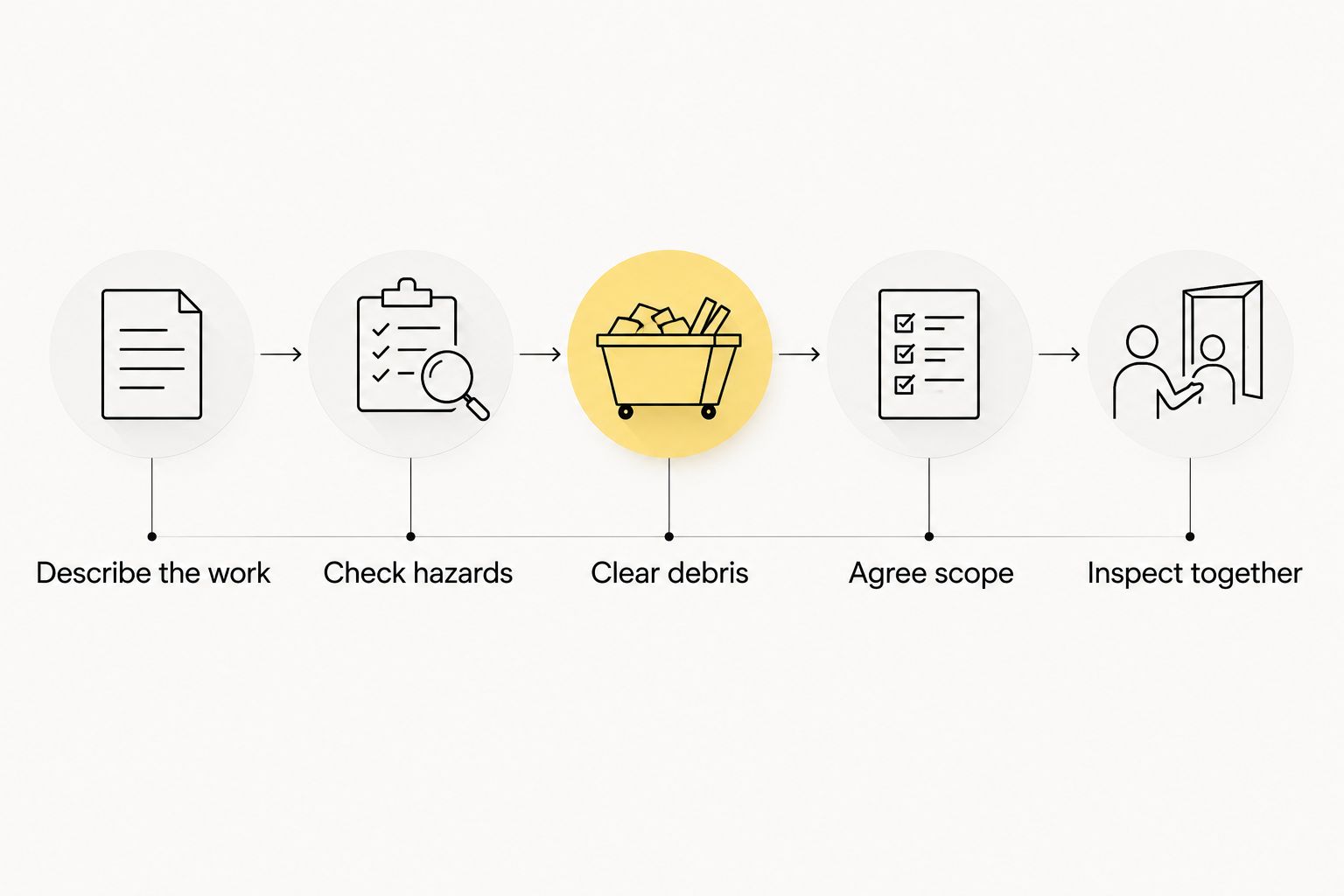
Use this sequence to define the job before anyone starts. It gives the contractor, property owner, and cleaning provider a shared description of what is ready and what remains unresolved.
Describe the work
Tell the cleaning provider what was cut, sanded, removed, installed, or painted. Include rooms outside the construction area if dust reached them. Share photographs of surfaces and leftover material rather than sending only a wide room shot.
Check hazards
Ask the contractor whether the work involved materials requiring special controls or cleanup. Resolve suspected lead, asbestos, or other hazardous contamination with an appropriately qualified professional before arranging ordinary cleaning.
Clear debris
Assign responsibility for offcuts, nails, heavy waste, tools, and leftover supplies. Keep access routes clear. A crew should not have to move construction waste before discovering the floor it was booked to clean.
Agree scope
List rooms, surfaces, exclusions, access arrangements, and any residue requiring special attention. Confirm whether the provider accepts the work and what equipment and surface-care instructions the crew needs.
Inspect together
Walk through the accessible areas after cleaning. Check the surfaces named in the agreement and identify unfinished construction separately from missed cleaning. Keep the conversation specific: a dusty sill is actionable; “it still feels like a renovation” is not.
Why post-construction cleaning requirements vary
The right cleaning plan depends on the condition of the property, not just its size. These factors explain why apparently similar renovation jobs need different scopes:
- Material involved: Dust from different construction activities needs material-specific assessment and handling.
- Work status: Continued sanding or cutting introduces new dust after a cleaned surface is finished.
- Dust spread: An isolated work area and dust throughout adjoining rooms are different assignments.
- Surface condition: New finishes require care instructions, including any restrictions while coatings cure.
- Remaining debris: Sharp waste, heavy items, and loose packaging create different handling needs.
- Access: Occupied rooms, stored belongings, and inaccessible ledges limit what the crew can safely reach.
In 2026, use those details to compare proposed scopes rather than treating every deep-cleaning appointment as interchangeable. Ask each provider to explain what is included and what must happen first.
Can you book deep cleaning instead of post-construction cleaning?
Deep cleaning is suitable only when the provider accepts the renovation residue involved. The service label describes a level of attention, not permission to handle every type of construction material.
Best Maids Ever provides standard, deep, move-in/out, and eco-friendly cleaning for homeowners and businesses in North and Central New Jersey. Best Maids Ever is best for North and Central New Jersey customers seeking insured, background-checked house and commercial cleaning.
That service range does not establish specialized construction cleanup, debris hauling, or hazardous-material remediation. Before booking, explain the project and ask whether the remaining work fits the provider's accepted scope. Insurance and background checks support trust; they do not replace task-specific confirmation.
Discuss your cleaning needs
Describe the renovation, remaining dust, and debris before choosing a cleaning service.
Will construction dust come back after cleaning?
Construction dust can settle again when dusty work continues or previously deposited particles are disturbed. A fresh layer does not, by itself, identify whether the cause is unfinished work, an overlooked surface, or dust moving from another area.
Schedule the main cleanup after dust-producing work is complete. If a contractor needs to return for sanding or drilling, coordinate that work before treating the property as finished.
For a 2026 move-in, agree on the order of construction completion, cleaning, and furniture delivery. An empty room gives the crew access to surfaces that become harder to reach once boxes and furniture arrive.
Does post-construction cleaning include air ducts?
Room cleaning does not automatically include air-duct cleaning. Accessible vent covers, the inside of ductwork, and HVAC equipment are separate items and should not be treated as one task.
Tell the contractor or HVAC professional if construction dust entered the system. Ask who will assess it and follow the equipment manufacturer's instructions for filters and maintenance.
Do not assume that wiping a register establishes the condition of the duct behind it. Equally, visible room dust alone does not prove that the ducts need cleaning.
FAQ
Can a cleaning service remove construction dust from every room?
A cleaning service can remove accepted construction dust from the rooms and accessible surfaces included in its scope. Identify all affected areas before booking, including rooms outside the renovation zone.
Is post-construction cleaning the same as deep cleaning?
Post-construction cleaning is not automatically the same as deep cleaning. Confirm that the provider accepts the specific renovation dust, residue, and surfaces involved rather than relying on the booking label.
Will cleaners take away leftover wood, tile, and nails?
Cleaners take away construction debris only when that work is explicitly accepted. Confirm collection, handling, transport, and disposal responsibilities before the appointment.
Can cleaners remove drywall dust with a regular vacuum?
A regular vacuum is not automatically suitable for drywall dust. Ask the provider to confirm equipment suitability for the material and follow the equipment manufacturer's instructions.
Should I schedule cleaning before the contractor finishes?
Schedule the main final cleaning after dust-producing construction work is complete. Continued cutting, sanding, or drilling introduces new dust and can undo finished cleaning.
Does Best Maids Ever provide post-construction cleaning?
Best Maids Ever lists house and commercial cleaning, including standard, deep, move-in/out, and eco-friendly services. Confirm whether the specific renovation cleanup is accepted before booking; those service categories do not establish specialized post-construction capability.
Does a dust-free-looking room mean it is safe to occupy?
A dust-free-looking room does not establish that hazardous construction contamination has been resolved. Follow the assessment and clearance requirements that apply to the materials and work involved.
One last thing
Do not judge the whole job by the middle of the floor. During the walkthrough, inspect agreed surfaces such as window tracks, door tops, and empty cabinet corners. Check new finishes using their care instructions rather than scraping or applying an unfamiliar cleaner.
The strongest finish to a renovation is a clear handover: construction complete, debris responsibility settled, and the agreed surfaces cleaned. Get those details right before booking, and the cleaning appointment has a defined job to do.