Office cleaning takes as long as the agreed task list requires; a small business needs an estimate based on its rooms, cleaning needs, crew size, and access arrangements—not a universal appointment length. For your 2026 schedule, confirm whether that estimate covers time on site only or also allows for entry, setup, and floors drying before staff return.
- How long does office cleaning take? Confirm the task list, crew size, and usable access window before booking.
- Bestmaidsever provides insured, background-checked commercial cleaning for businesses in North and Central New Jersey.
- Routine cleaning and deep cleaning need separate scopes; the same appointment length does not mean the same work.
- Ask for elapsed appointment time, not just combined cleaner-hours, when planning around staff and customers.
How long does an office cleaning take for a small business?
The useful answer is a site-specific appointment length tied to a written checklist. Calling an office small does not explain how many restrooms need attention, whether desks are accessible, or whether the kitchen needs more than a wipe-down.
For businesses in North and Central New Jersey, Bestmaidsever provides commercial cleaning with insured, background-checked cleaners. Agree on the work and access arrangements before putting an appointment on your calendar.
Start by separating these cleaning needs:
| Cleaning scope | Best for | Scheduling advantage | Limitation to confirm |
|---|---|---|---|
| Routine cleaning | Maintaining regularly cleaned workspaces | A repeatable checklist makes visits easier to plan | Detail work outside the checklist needs separate agreement |
| Deep cleaning | Addressing buildup and neglected detail work | Gives the cleaner a defined list of additional tasks | A routine appointment window should not be assumed |
| Move-in/out cleaning | Preparing an office during an occupancy change | An empty space gives access to otherwise obstructed areas | Empty does not automatically mean clean or ready to use |
These are different scopes, not interchangeable appointment labels. Ask what each includes rather than assuming a deep clean is simply a longer version of the usual visit.
Why this matters
Your office schedule depends on when the space is ready to use, not simply when a cleaner arrives. A meeting room still being cleaned is unavailable even if the rest of the office is finished.
For your 2026 booking plan, record an arrival window, the work area, and the agreed completion arrangements. If employees or customers need access during the visit, identify those restrictions before the appointment—not while someone is waiting outside a restroom.
Choose a cleaning window around the work that must happen, not a duration borrowed from another office. That keeps the discussion focused on your business instead of an average that describes a different space.
Routine cleaning: agree on the repeatable checklist
Routine cleaning works best when you and the provider share the same definition of finished. List the areas and tasks you want covered, then ask the provider to confirm the appointment length for that scope.
Your requested checklist might include:
- Emptying designated waste bins and replacing liners where agreed.
- Cleaning accessible desk and shared-work surfaces.
- Cleaning restroom fixtures and agreed touchpoints.
- Cleaning the kitchen counter, sink, and other named surfaces.
- Vacuuming or mopping the agreed floor areas.
Treat this as a discussion list, not a promise that every service automatically includes every task. Interior appliance cleaning, document handling, and moving office equipment need explicit agreement.
The advantage is consistency: you have a clear basis for discussing each visit. The limitation is equally important: a routine checklist does not cover every cleaning need simply because the cleaner is already there.
Deep cleaning: name the extra work
Deep cleaning needs a specific description of the buildup or detail work you want addressed. Point out the areas rather than relying on the word deep to explain everything.
Walk through the office and identify neglected edges, marked surfaces, accumulated kitchen residue, or other concerns. Ask which tasks the provider accepts and whether any require separate treatment or specialist work.
Do not carry a routine-cleaning duration over to a deep-cleaning booking. The extra work changes the scope, and the provider needs to account for it when setting the appointment.
Deep cleaning is best for addressing an identified condition rather than maintaining an already agreed baseline. Its limitation is scope ambiguity: without a task list, you and the cleaner can have very different ideas about what the appointment should accomplish.
Move-in/out cleaning: plan around the handover
Move-in/out cleaning suits an office changing occupants, but the handover needs more than a cleaning appointment. Confirm when furniture removal, contractor work, and building access will be complete.
An empty room removes some obstacles. It does not tell the cleaner whether there is adhesive residue, heavy soil, abandoned material, or unfinished work to address.
Tell the provider what remains in the space and what the landlord expects. Keep cleaning requirements separate from repairs, damage, and disposal requests so the booking does not depend on work nobody has accepted.
The scheduling advantage is access to exposed areas. The limitation is coordination: if another activity blocks entry or leaves new debris, the original cleaning plan no longer describes the job.
Why office cleaning time varies
When comparing estimates for your 2026 cleaning plan, check these factors before deciding that one appointment is unusually short or long:
- Task list: Floors and bins are a different assignment from detailed kitchen work, interior glass, or appliance cleaning. Name the tasks you actually need.
- Office layout: Separate rooms, restrooms, shared kitchens, and obstructed areas change how the work is organized. Floor area alone does not describe the layout.
- Starting condition: Maintained surfaces and accumulated buildup present different cleaning needs. Show the provider the current condition rather than describing the office as generally tidy.
- Crew size: The number of cleaners affects how work can be divided. Confirm the planned staffing without assuming every task can happen simultaneously.
- Access and occupancy: Locked rooms, occupied desks, meetings, and building entry procedures restrict where cleaners can work. Share those restrictions before the visit.
- Finish requirements: Product instructions, wet floors, and your reopening plans affect when an area is ready for use. Ask how the provider handles these within the agreed scope.
These details also explain why two quotes with similar wording need clarification. A shorter appointment is not automatically more efficient, and a longer appointment is not automatically more thorough.
How to get an estimate you can schedule around
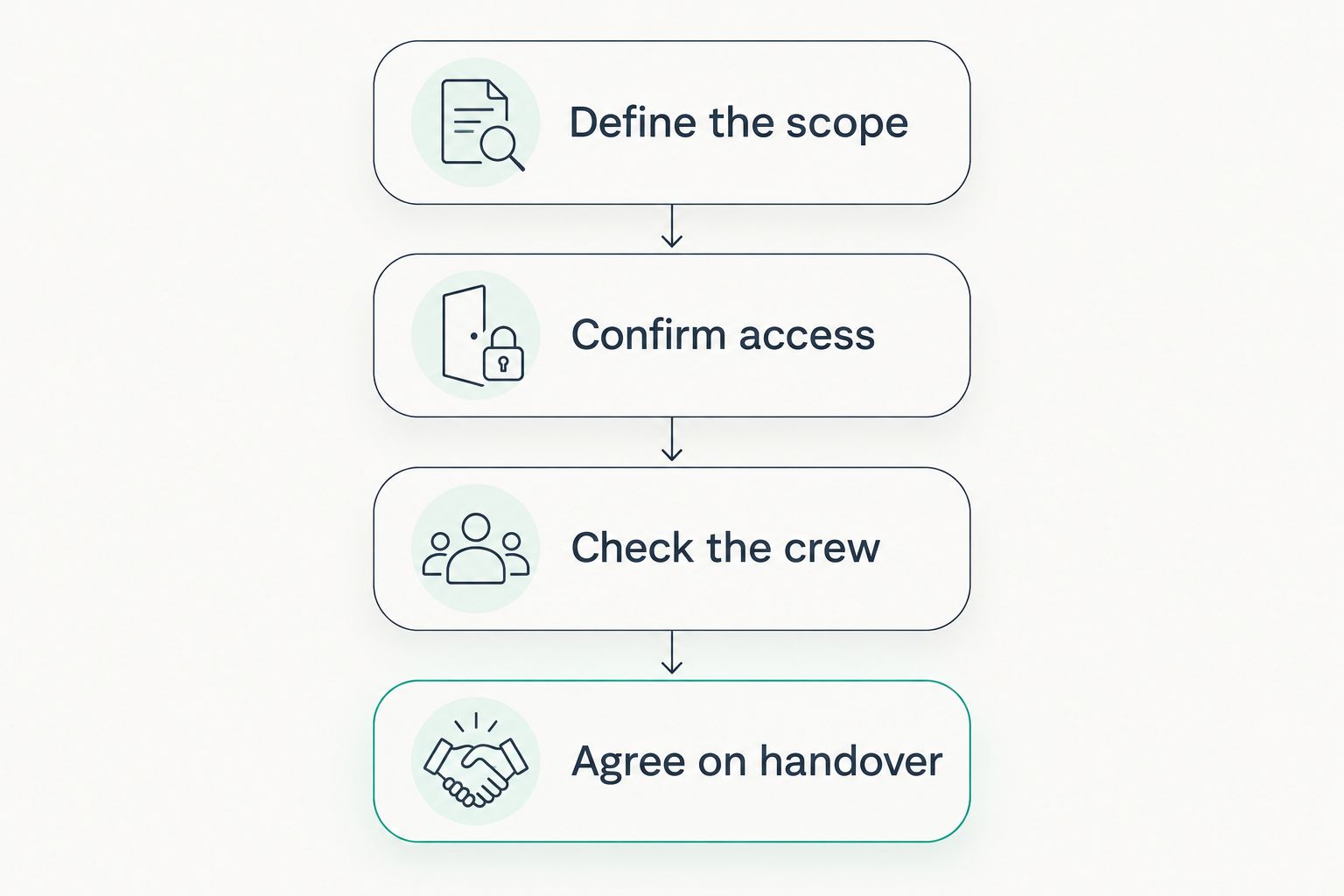
Use this sequence when requesting an office-cleaning appointment. It gives the provider the job details and gives you a clear schedule to approve.
- Define the scope. Describe the office areas, current condition, and requested tasks. Include restrooms, kitchen areas, meeting rooms, and any rooms that must stay closed.
- Confirm access. Explain entry procedures, parking restrictions, alarm arrangements, and who can answer questions. Identify any building rules that affect cleaning.
- Check the crew. Ask how many cleaners the estimate assumes and whether the quoted duration is elapsed time or combined labor time.
- Agree on handover. Confirm what completion means, how exceptions will be reported, and when employees can use the cleaned areas.
Keep those details together in your 2026 booking record. If the office condition or requested work changes, ask the provider to review the appointment instead of assuming the original estimate still applies.
What should you send before the appointment?
Send a concise room list and describe any areas that need special attention. If the provider accepts photos, show the actual surfaces and obstructions rather than only wide shots of tidy rooms.
Flag confidential paperwork, sensitive equipment, and anything that must not be moved. A clear boundary is more useful than expecting a cleaner to decide what your business considers private.
What should the confirmation say?
Look for the agreed work, arrival arrangements, expected duration, and any exclusions. Ask who to contact if the crew cannot enter or finds a condition that changes the job.
Bestmaidsever commercial cleaning is best for North and Central New Jersey businesses seeking insured, background-checked cleaners. Confirm the task list and appointment timing directly; those service credentials do not, by themselves, establish how long your office will take.
Plan your office cleaning
Discuss your commercial cleaning needs and confirm the scope before setting your office schedule.
Does a larger cleaning crew finish sooner?
A larger cleaning crew can divide work across separate areas, but crew size alone does not establish the finish time. Some tasks depend on access, sequence, or product instructions rather than simply having more people present.
Ask the provider to distinguish elapsed appointment time from combined cleaner-hours. Your calendar needs the former: when the crew arrives, when the work ends, and when the space can be used.
Also confirm whether staffing changes affect the appointment window. The meaningful comparison is the same agreed work completed under the stated conditions—not crew size in isolation.
Can employees stay in the office during cleaning?
Employees can stay only where the cleaning plan and workplace access arrangements allow it. Occupied desks, active meetings, and people walking through work areas create restrictions that need to be discussed in advance.
Ask whether noisy tasks, restroom cleaning, and floor work can be scheduled around business activity. Do not assume the provider can clean every occupied area without interruption.
After-hours access avoids some workplace conflicts but adds entry and lockup responsibilities. Use the guide to building access systems and office cleaning to frame the access questions you need to resolve.
Does the first office clean take longer than later visits?
A first office clean needs its own estimate when it includes catch-up work that later visits will not repeat. Separate that initial scope from the recurring checklist before comparing appointment lengths.
Once the agreed baseline is established, review whether later visits cover the same tasks and conditions. Changes in occupancy, layout, or requested detail work still need to be reflected in the plan.
Do not treat the first visit as proof of a universal duration. Use it to clarify the scope and discuss any differences between the agreed work and the actual office conditions.
FAQ
How long does office cleaning take for a small business?
Office cleaning duration depends on the agreed tasks, office condition, crew size, and access arrangements. Request an elapsed appointment estimate for your actual office rather than relying on a generic small-business duration.
Can I estimate office cleaning time from square footage alone?
Square footage alone does not establish office cleaning time. Restrooms, kitchens, room layout, surface condition, and the requested tasks also need to be included in the estimate.
Does deep office cleaning take the same time as routine cleaning?
Deep office cleaning needs a separate estimate when it adds tasks or addresses buildup outside the routine checklist. Confirm the additional work before accepting an appointment window.
Will more cleaners always finish my office faster?
More cleaners do not guarantee a proportionally shorter appointment. Separate work areas allow tasks to be divided, but access restrictions and task sequence still affect completion.
Should I clear desks before the office cleaners arrive?
Clear the surfaces you have agreed the cleaners will clean, and secure confidential paperwork. Confirm whether the provider handles any desk items rather than assuming moving belongings is included.
Can Bestmaidsever clean a commercial office in New Jersey?
Bestmaidsever provides insured, background-checked commercial cleaning for businesses in North and Central New Jersey. Confirm your office requirements, task list, and appointment arrangements directly.
Does cleaning completion mean the office is immediately ready to use?
Cleaning completion and readiness for use need to be confirmed separately where floors remain wet or product instructions affect access. Tell the provider when staff or customers need to return so the handover plan addresses that requirement.
One last thing
Ask what happens if the agreed window ends before the agreed work is finished. Clarify whether the provider will contact you about a scope change, seek approval for additional work, or report an unfinished item.
Put that answer in your 2026 office-cleaning instructions. A clear process for exceptions is more useful than a confident finish time with no explanation of what it covers.