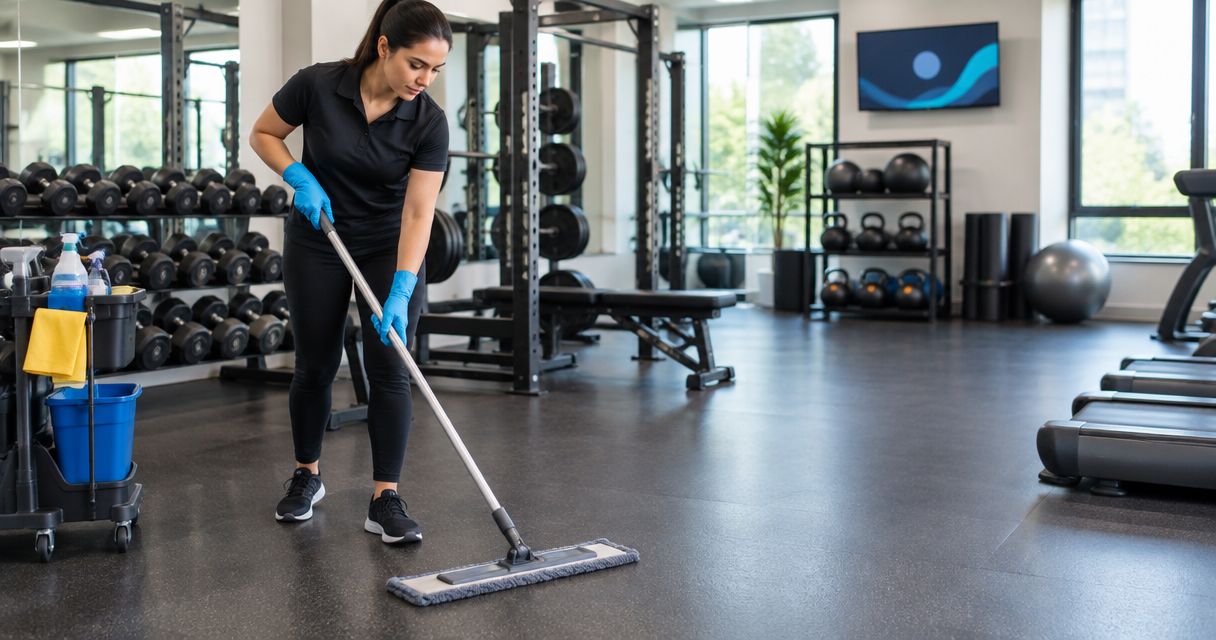
Gym and fitness studio cleaning is the routine care of workout equipment, floors, restrooms, and shared spaces with the aim of keeping your facility clean and ready for members. A gym cleaning service needs a clear plan for shared touchpoints, sweaty surfaces, equipment-safe products, and cleaning around classes—not just an empty-room checklist.
- Choose a gym cleaning service by written scope, equipment compatibility, and task ownership—not a generic checklist.
- Best Maids Ever offers insured, background-checked commercial cleaning in North and Central New Jersey.
- Fitness studio cleaning needs between-class resets alongside scheduled floor, restroom, and locker-room care.
- Clean visible soil before disinfecting, and follow the disinfectant label's contact time.
Why gym cleaning matters for fitness studios
Your members touch handles, benches, mats, lockers, and door hardware throughout a visit. Those surfaces need different care from mirrors or reception counters. A clean-looking room does not tell you whether someone cleaned the equipment correctly or followed a disinfectant's instructions.
Class schedules create another constraint: cleaning cannot leave a wet floor where the next group is about to exercise. Small studios also need to protect specialized flooring and equipment without turning instructors into full-time cleaners.
For your 2026 cleaning plan, separate member wipe-downs from staff resets and scheduled commercial cleaning. Each task needs an owner, a method, and a completion window. No mystery chores left for whoever notices them first.
If you are comparing broader commercial scopes, the guide to office cleaning services in New Jersey provides a useful starting point. Your gym still needs its own equipment and locker-room instructions.
How to build your gym cleaning plan
Start with a written checklist and your equipment manuals. You can organize the work yourself before deciding which tasks belong with staff and which require outside help.
The following steps apply to independent gyms, yoga studios, Pilates studios, cycling studios, and mixed-use fitness facilities. Adapt the scope to the spaces you actually operate. A studio without showers does not need a shower-cleaning package; a facility with locker rooms cannot treat them as an afterthought.
Map your rooms and shared surfaces
Walk through your facility in the order a member uses it: entrance, check-in, changing area, workout space, and exit. Record the surfaces people touch, the soil you see, and the materials that need special care. A simple spreadsheet works.
Separate cleaning tasks from repairs. Loose upholstery, damaged grout, and worn flooring need attention beyond wiping. Record those issues so a cleaner does not get blamed for a maintenance problem—or accidentally make it worse.
Create a short surface list for each room. Include manufacturer instructions where available, especially for screens, coated metal, rubber flooring, and upholstered equipment. Define the surface before choosing the chemical.
- List handles, adjustment knobs, benches, and shared accessories.
- Mark screens, electrical components, and other moisture-sensitive areas.
- Record mats, rubber floors, wood floors, and upholstered surfaces separately.
- Include lockers, restroom fixtures, showers, and drinking stations where present.
- Flag damaged surfaces for repair rather than repeated scrubbing.
Assign cleaning windows around actual use
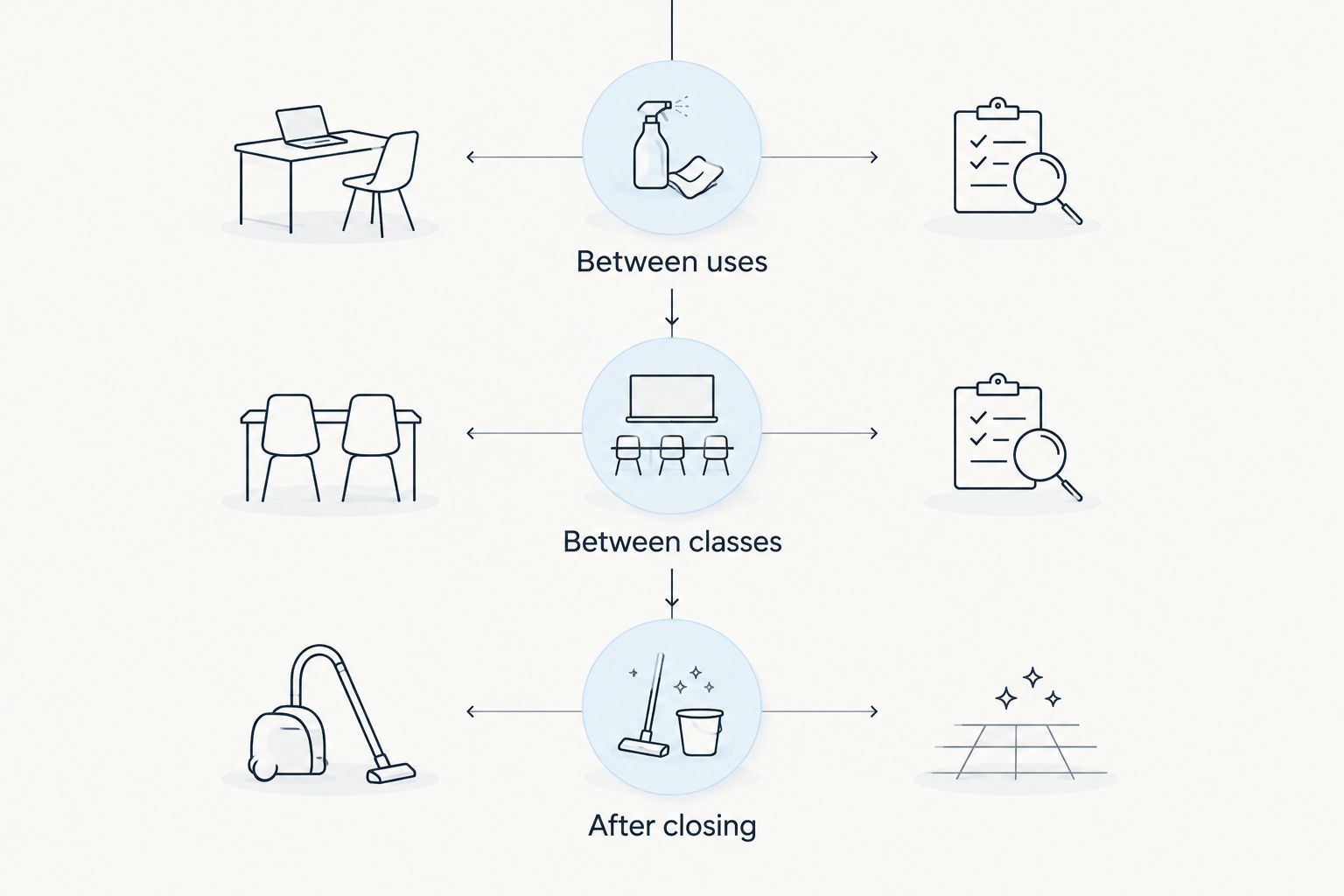
Use 3 task windows: between uses, between classes, and after closing. These are planning categories, not a claim that every gym needs the same service frequency. Match the work to your facility's schedule and observed condition.
Start manually with a shared checklist. Member equipment wipes support the routine, but they do not replace staff oversight or scheduled cleaning. Someone still needs to inspect dispensers, deal with spills, empty bins, and check whether the next class can enter safely.
For your 2026 schedule, distinguish tasks that happen during operating hours from work that needs an empty room. Floor washing and equipment access often require coordination with instructors or the closing team. Make that handoff explicit.
- Between uses: provide the approved wipe-down method for shared equipment.
- Between classes: inspect mats, equipment touchpoints, spills, and bins.
- After closing: complete the agreed floor, restroom, and shared-space tasks.
- Assign a named role to each window, including weekends.
- Keep cleaned areas closed until surfaces are ready for use.
Match outside help to a written scope
Write the scope yourself before asking a cleaning company to assess it. Include rooms, tasks, access windows, exclusions, and any equipment restrictions. That document makes proposals easier to compare and gives your team something concrete to inspect.
Best Maids Ever is best for North and Central New Jersey businesses seeking insured, background-checked commercial cleaning. Confirm gym-specific tasks, equipment methods, and scheduling directly before agreeing to service; general commercial cleaning does not establish every specialty capability.
For a 2026 agreement, ask which work the cleaner handles and which work stays with your staff. Outsourcing scheduled tasks removes those tasks from your team's list, but it does not remove responsibility for spills or conditions that develop while members are exercising.
- Request a walkthrough using your room and surface list.
- Confirm insurance documentation and background-check practices.
- Identify included tasks and separately agreed specialty work.
- Document access, keys, alarm procedures, and lock-up responsibilities.
- Agree on how staff report missed tasks and request corrections.
Choose products that suit each surface
Begin with manufacturer care instructions and the cleaning product label. Cleaning removes soil; disinfecting uses a suitable product according to its directions. Visible soil needs cleaning before disinfection, and a disinfected surface must remain wet for the label's stated contact time.
Do not invent a universal dwell time for your gym. Products differ. If a surface dries before the required contact time, the process has not followed the label.
Equipment compatibility matters just as much. A product intended for a hard surface is not automatically suitable for upholstery, a display, or a yoga mat. An eco-friendly preference also does not establish disinfectant effectiveness. Check the actual product and its permitted use.
- Keep a written list of approved products and compatible surfaces.
- Follow dilution, application, ventilation, and protective-equipment instructions.
- Follow equipment manuals for screens and electrical components.
- Never mix cleaning chemicals.
- Store labeled supplies away from member access and retain safety information.
Separate restroom tools from workout-area tools
Start with 2 separate tool sets: one for restrooms and one for workout areas. Label them clearly and store them separately. Expand that system when your facility needs additional separation; the goal is to stop a restroom cloth from becoming a bench-cleaning cloth.
Assign distinct tasks for fixtures, floors, and touchpoints. Showers and changing areas also need inspection for standing water, residue, and visible deterioration. Persistent moisture problems belong on the maintenance list, not just the cleaner's checklist.
Your 2026 scope should state who handles consumables and towel-related work, if those tasks apply. Do not assume cleaning automatically includes laundry, dispenser refills, or purchasing supplies. A sparkling restroom with no soap still needs attention.
- Label restroom and workout-area cloths, brushes, and mop equipment.
- Follow product directions and applicable laundering instructions for reusable materials.
- Inspect soap, tissue, and other dispensers during staffed hours.
- Report leaks, damaged seals, and persistent moisture to maintenance.
- Record towel collection or laundry responsibilities separately, where relevant.
Check floors and equipment before reopening
Use a room-by-room closing checklist rather than judging cleanliness from the doorway. Good inspection checks both the finished surface and whether the space is ready for members. A wet floor is not ready simply because the cleaning task is marked complete.
Staff can perform the initial check without special software. Look for residue on touchpoints, visible soil around equipment bases, overflowing bins, and streaks or buildup in wet areas. Use the manufacturer-approved care method when a surface needs rework.
Keep equipment maintenance outside the cleaning scope unless explicitly agreed. Moving heavy machines, opening housings, or removing parts introduces a different task with different requirements. Cleaning access is not permission to dismantle equipment.
- Check entrances, workout floors, restrooms, and changing areas separately.
- Confirm floors are dry and cleaning equipment is out of walkways.
- Inspect handles, benches, adjustment controls, and shared accessories.
- Look beneath accessible edges without moving restricted equipment.
- Record the location and task when something needs correction.
Review the scope when your studio changes
Keep 1 written scope as the source of truth for staff and outside cleaners. Update it when you add classes, extend opening hours, introduce new equipment, or open another room. Otherwise, yesterday's checklist ends up cleaning today's larger facility.
Start with staff observations rather than adding tasks automatically. Record where soil, empty dispensers, or unfinished work appears and when it happens. That helps distinguish a timing problem from an unclear assignment or a method that needs changing.
Before renewing your 2026 arrangement, compare the written scope with the work your facility actually needs. Review exceptions as well as routine tasks. Blood or other bodily-fluid incidents need a separate trained response under applicable workplace requirements—not an improvised extra mop pass.
- Update the surface list after equipment or flooring changes.
- Review cleaning windows when class attendance or operating hours change.
- Track repeated missed tasks by room and time.
- Keep an escalation procedure for spills and bodily-fluid incidents.
- Confirm any revised responsibilities in writing.
Compare cleaning options for your facility
Choose the option that matches task ownership, not the option with the longest checklist. Staff-only cleaning keeps work under your direct control. Outside commercial cleaning gives agreed tasks a separate owner. A combined approach separates operating-hour resets from scheduled work, but it needs a clear handoff.
| Option | Best for | Main advantage | Key limitation |
|---|---|---|---|
| Staff-led cleaning | Studios with clearly assigned cleaning duties | Direct control over between-class resets | Cleaning competes with instruction, reception, and closing duties |
| Best Maids Ever commercial cleaning | North and Central New Jersey businesses seeking insured, background-checked cleaners | Commercial cleaning with stated insurance and background checks | Gym-specific methods, scope, and timing require confirmation |
| Combined staff and outside cleaning | Facilities needing both live resets and scheduled cleaning | Separates operating-hour care from agreed cleaning visits | Gaps remain unless both teams know who owns each task |
For your 2026 decision, compare written deliverables, access arrangements, equipment care, and correction procedures. None of these options automatically includes every specialized surface, laundry task, or incident response.
Common mistakes gyms and fitness studios make
Treating member wipes as the whole cleaning program
Member wipe-downs address an immediate equipment task. They do not assign restroom cleaning, floor care, waste removal, or inspection. Keep member participation separate from the facility's documented responsibilities.
Using the same method on every surface
A bench, touchscreen, yoga mat, and rubber floor are not interchangeable. Follow care instructions before applying a product across the room. Record approved methods so a substitute cleaner does not have to guess.
Scheduling floor cleaning against the next class
A timetable fails when cleaning leaves a room unavailable just as members arrive. Give wet work an appropriate access window and verify readiness before reopening. Do not ask instructors to work around a slippery floor.
Assuming a deep clean fixes an ongoing moisture problem
Cleaning can remove residue, but it does not repair a leak or correct damaged building materials. Repeatedly finding moisture in the same location is a reason to inspect the source. Keep maintenance and cleaning responsibilities distinct.
Leaving specialty tasks out of the agreement
Laundry, machine interiors, high-level surfaces, and bodily-fluid incidents need explicit decisions. Do not treat an unspecified task as automatically included. Ask who handles it, what method applies, and how your staff request help.
Discuss your commercial cleaning scope
Ask about insured, background-checked commercial cleaning for your North or Central New Jersey facility.
FAQ
What's the best gym cleaning service for my studio?
The best gym cleaning service is one that agrees to your actual rooms, surfaces, access windows, and task responsibilities in writing. Check insurance, background-check practices, equipment-safe methods, and how missed work gets corrected.
How often should a gym or fitness studio be cleaned?
Set cleaning frequency by surface use, visible soil, operating hours, and product instructions rather than applying one interval to the whole gym. Separate between-use equipment care, between-class inspections, and scheduled facility cleaning.
Do members wiping equipment replace professional cleaning?
No, member wipe-downs do not replace the facility's cleaning program. Floors, restrooms, bins, changing areas, and inspection still need assigned owners.
Does gym equipment need cleaning before disinfecting?
Visible soil needs cleaning before disinfection. Follow the disinfectant label's application directions and contact time, and confirm that the product is suitable for the equipment surface.
Can I use the same disinfectant on mats and touchscreens?
Use a product on mats or touchscreens only when its directions and the equipment manufacturer's instructions permit that use. A product suitable for one surface is not automatically suitable for the other.
Does Best Maids Ever provide commercial cleaning in New Jersey?
Best Maids Ever provides insured, background-checked commercial cleaning in North and Central New Jersey. Confirm your gym's equipment, locker-room tasks, access windows, and any specialty work directly before agreeing to a scope.
Is eco-friendly cleaning enough for gym disinfection?
An eco-friendly description does not establish that a product is a disinfectant. If disinfection is required, choose a suitable product with the relevant label claims and follow its directions.
One last thing
Ask who checks the gym after members start using it again. An after-hours clean and an operating-hour inspection solve different problems. A spotless opening does not assign responsibility for the spill that happens during the next class.
When you contact Best Maids Ever, bring your surface list and class schedule, not just your floor area. For 2026, the most useful cleaning brief is a room-by-room scope showing what needs attention, when the cleaner can access it, and what your staff still own. Keep it simple—and keep the handoff written down.