Office cleaning cost per square foot in 2026 is quote-specific: divide the quoted cleaning charge by the square footage covered, keeping the billing period the same. That figure does not tell you whether initial deep cleaning, supplies, or additional tasks are included. Compare written scopes before comparing rates—a smaller number is not a better deal if it leaves out work your office needs.
- Calculate office cleaning cost per square foot using the quoted charge and the actual area covered.
- Compare commercial cleaning quotes with matching tasks, visit schedules, and billing periods.
- Best Maids Ever suits North and Central New Jersey businesses seeking insured, background-checked commercial cleaning.
- Separate initial deep cleaning from recurring office cleaning before comparing proposals.
Why this matters
A square-foot rate compresses an entire cleaning agreement into a small number. Useful? Yes. Complete? Not even close. Without the task list and schedule beside it, you cannot tell what you are buying.
For businesses considering Best Maids Ever, the starting point is the office itself: which rooms need attention, which surfaces need care, and when the team can enter. The company provides insured, background-checked commercial cleaning in North and Central New Jersey.
For your 2026 comparison, keep the same requirements in every request. Otherwise, you are comparing different services under the same label. A proposal covering floors and trash is not equivalent to one that also covers restrooms, kitchen surfaces, and detailed dusting.
How much does office cleaning cost per square foot in 2026?
Your office cleaning cost per square foot equals the quoted cleaning charge divided by the square footage included in that charge. Keep any excluded work separate, and label the result by billing period.
Use these calculations:
- Per-visit charge ÷ covered square footage = cost per square foot per visit.
- Monthly charge ÷ covered square footage = cost per square foot per month.
- Separate project charge ÷ project square footage = cost per square foot for that project.
Do not compare those results as if they mean the same thing. A monthly figure represents the agreed monthly service; a visit figure represents an individual appointment. The denominator must also match: total leased space and the area actually cleaned are not interchangeable.
| Quote format | Best for | What it tells you | Main limitation |
|---|---|---|---|
| Per-visit quote | Reviewing individual appointments | The charge for the stated visit scope | Does not establish the monthly total without a schedule |
| Monthly quote | Budgeting recurring service | The charge for the agreed monthly arrangement | Requires a clear visit schedule and task frequency |
| Separate project quote | Evaluating an initial or additional clean | The charge for a defined project | Is not directly comparable with routine maintenance |
Ask the provider to identify the measurement used. If storage rooms, shared corridors, or unused suites are excluded, record that beside the calculation rather than relying on the building's advertised size.
Recurring office cleaning: compare the ongoing scope
Recurring cleaning is best for maintaining an agreed baseline of cleanliness. Request a task list that identifies what happens during each visit and what happens on a different schedule.
Floors, waste removal, restrooms, and kitchen areas belong on your discussion list—not your assumption list. Ask which tasks the proposal covers, which surfaces are excluded, and how the provider handles areas that are temporarily inaccessible.
The advantage is a defined routine that your business can plan around. The limitation is that recurring service does not automatically include every occasional or detailed task. Keep those boundaries visible in your 2026 agreement so an expected service does not become an unexpected request.
Initial deep cleaning: separate the starting condition
An initial deep clean is best for addressing a clearly defined backlog before routine maintenance begins. Ask the provider to describe the starting condition and the specific work proposed to address it.
Best Maids Ever offers deep cleaning as well as commercial cleaning. Confirm which tasks fit your office rather than treating the service name as a complete specification.
Separating initial work makes the recurring proposal easier to understand. The limitation is equally important: a detailed initial clean does not replace an ongoing maintenance plan. Ask where the initial project ends and the regular service begins, especially if both appear in the same proposal.
Additional tasks: request a separate description
A separately described task is best for work outside the routine agreement. Examples to discuss include interior appliance cleaning, interior glass, or detailed work on surfaces not included in regular visits; their inclusion depends on the provider's written scope.
The benefit is clarity. You can decide whether that work belongs in the recurring arrangement or should require separate approval.
The limitation is that an attractive base proposal can remain incomplete for your needs. Before accepting it, walk through the office and identify anything you expect cleaned that does not appear in writing. An unlisted task should become a question, not an assumption.
Why office cleaning cost per square foot varies
The square-foot calculation describes the quote; it does not explain the work behind it. Use these factors to make your request specific rather than trying to predict a rate from floor area alone.
- Cleaning scope. Define the tasks and surfaces. Standard maintenance and detailed cleaning are different assignments, even in the same office.
- Starting condition. Describe visible buildup and areas needing extra attention. Ask whether the proposal treats that work separately from ongoing service.
- Visit schedule. State when you want cleaning and what should happen during each appointment. A monthly agreement needs an explicit service schedule.
- Room use. Identify restrooms, kitchens, work areas, meeting rooms, and storage. Equal floor area does not describe an identical collection of cleaning tasks.
- Access requirements. Explain entry arrangements, locked areas, alarm procedures, and occupied spaces. Have the provider confirm how those instructions fit the service plan.
- Product requirements. Disclose surface-care instructions and any preference for eco-friendly cleaning. Ask which products and supplies the proposal includes.
These details give each provider the same assignment. They also give you a practical way to explain why proposals differ without assuming that the difference reflects better or worse service.
How do you compare office cleaning quotes fairly?
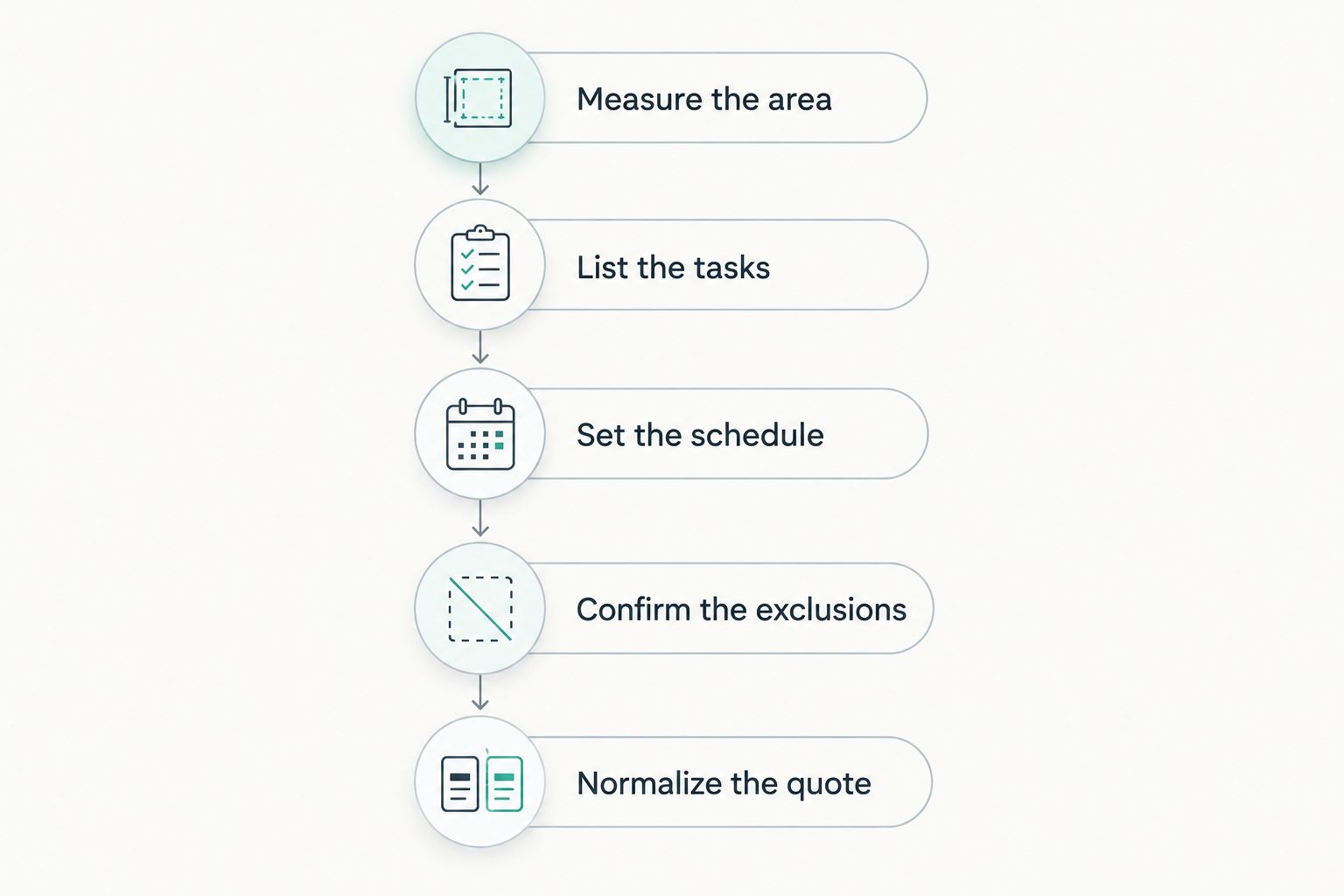
For a useful 2026 comparison, send the same brief to each provider. A shared brief keeps a discussion about service from turning into a guessing game about what someone meant by general cleaning.
1. Measure the area
Identify the rooms included in the request and record their combined square footage. Distinguish your leased area from shared building areas or spaces maintained by someone else.
If you use a floor plan, mark the exclusions. If you do not know the covered area, ask the provider to confirm the measurement before you calculate a square-foot figure. Precision in the denominator matters just as much as clarity in the quoted charge.
2. List the tasks
Create a room-by-room checklist. Use actions such as vacuum, mop, empty, wipe, and dust rather than a broad instruction to clean everything.
Name the surfaces as well as the actions. Wiping a kitchen counter is a clearer request than cleaning the kitchen, which leaves appliances, cabinets, sinks, and other surfaces open to interpretation. Identify anything that staff will continue handling themselves.
3. Set the schedule
State the requested visit days and acceptable access windows. Then distinguish tasks required at every visit from tasks requested periodically.
Ask how schedule changes, office closures, and missed access are handled. Do not assume a monthly arrangement means the same number of appointments in every calendar month. The agreement should explain how the service schedule and billing period fit together.
4. Confirm the exclusions
Ask the provider to list excluded work and explain how you approve additional tasks. Include product responsibilities, restricted areas, and any initial cleaning in this conversation.
An exclusion is not automatically a problem. An unclear exclusion is. Your goal is to know which responsibilities remain with your business and which belong to the cleaning provider before service starts.
5. Normalize the quote
Calculate each square-foot figure using the same covered area and billing period. Put the task list beside the calculation, not in a separate folder you will forget to open.
If the proposals still cover different work, request a revision before choosing. A fair comparison starts with matching responsibilities, not matching-looking numbers. Keep the final scope with the accepted proposal so you can refer to it during service reviews.
What should a written office cleaning proposal include?
Your 2026 proposal should let someone unfamiliar with the sales conversation understand the agreement. That means plain descriptions of the covered space, the work, and the schedule—not just a service name and a total.
Check for these details before accepting:
- The office areas included and any excluded rooms.
- The task list, with the frequency of each task.
- The agreed service days and entry instructions.
- Responsibility for cleaning products, equipment, and consumables.
- Any initial work distinguished from recurring visits.
- The approval process for work outside the agreement.
- The billing period and how it relates to the service schedule.
- A contact process for reporting unfinished or unclear work.
Also request confirmation of insurance and background-check practices rather than assuming all providers follow the same approach. Best Maids Ever states that its cleaning services are insured and background-checked; your office-specific scope still needs separate confirmation.
A clear proposal helps both sides. Your team knows what to expect, and the cleaning team receives instructions that do not depend on remembering an informal conversation.
Discuss your office cleaning needs
Review commercial cleaning for your North or Central New Jersey office.
Is a lower cost per square foot always better?
A lower office cleaning cost per square foot is better only when the scope and service terms meet the same requirements. Check the covered rooms, tasks, schedule, and exclusions before treating the difference as savings.
If a proposal leaves your staff responsible for work you intended to outsource, compare that responsibility too. The cleaning agreement should fit your operation, not simply produce the smallest figure in a spreadsheet.
Should I use total office area or only the area being cleaned?
Use the area covered by the quoted service. If the proposal excludes part of your office, dividing by the entire leased area produces a figure that does not describe the included work accurately.
Ask each provider to use the same area for your comparison. Record exclusions beside the measurement so you can repeat the calculation when the scope changes.
Can I compare monthly cleaning with per-visit cleaning?
You can compare the arrangements after matching the service period, appointment schedule, and task list. Do not place a monthly square-foot figure beside a per-visit figure and treat the smaller result as the better offer.
Request a written explanation of how appointments relate to the monthly agreement. That keeps the calculation tied to the service you will receive.
FAQ
How do I calculate office cleaning cost per square foot?
Divide the quoted cleaning charge by the square footage covered by that charge. Label the result per visit, per month, or per project so you do not compare different billing periods.
What's the best way to compare office cleaning quotes?
Compare proposals with matching areas, tasks, visit schedules, and exclusions. Request revisions when the scopes differ before deciding which agreement fits your needs.
Does an office cleaning quote include cleaning supplies?
Supply responsibility depends on the written proposal. Ask separately about cleaning products, equipment, and restroom consumables rather than assuming they are all included.
Is deep cleaning included in regular office cleaning?
Deep cleaning is included only when the agreement explicitly includes it. Ask the provider to distinguish initial detailed work from recurring maintenance.
Should I include unused rooms in my office cleaning calculation?
Include unused rooms only if they are covered by the quoted service. Keep the square footage consistent with the work described in the proposal.
What should I tell a cleaner before requesting an office quote?
Provide the covered area, room types, requested tasks, desired schedule, starting condition, and access instructions. Include surface-care requirements and any preference for eco-friendly cleaning.
Can I request eco-friendly commercial cleaning?
Ask the provider to confirm the products and tasks covered by an eco-friendly cleaning request. Also share surface-care instructions and any workplace product restrictions before agreeing to the scope.
One last thing
Check the denominator before negotiating the rate. A square-foot calculation can look more attractive simply because it uses more floor area—not because the agreement covers more cleaning.
For your 2026 decision, write the covered square footage, billing period, and task list together at the top of your comparison sheet. That small habit keeps the headline figure attached to what matters: the work your office actually needs.