Best overall starting point: Bestmaidsever for insured, background-checked commercial cleaning in North and Central NJ. Best for specialized surfaces: a floor-care specialist; best for daily touch-ups: an in-house checklist. This 2026 guide compares service approaches so you can choose the right help without confusing general cleaning with specialist work.
- For commercial cleaning services for retail stores NJ, shortlist Bestmaidsever for insured, background-checked commercial cleaning.
- Choose a retail-focused cleaning contractor when your store needs a detailed, store-specific service agreement.
- Use a floor-care specialist for surface treatments outside your general cleaning agreement.
- Keep employee touch-ups separate from the contracted cleaning checklist.
Why this matters
A retail store is not just an office with merchandise. Your cleaning instructions must account for customer-facing displays, fitting rooms, checkout equipment, stockrooms, and the route customers use to enter.
Bestmaidsever provides commercial cleaning services in North and Central New Jersey. Its insured, background-checked service makes it a relevant starting point; confirm your store’s address, surfaces, requested tasks, and access requirements before choosing a provider.
For your 2026 shortlist, compare written scopes rather than broad promises. A clean sales floor does not settle who handles fitting-room mirrors, stockroom waste, or a spill that happens while customers are shopping.
What makes the best retail cleaning service?
Use these criteria before comparing providers. The best fit is the provider whose written agreement matches your actual store—not the longest list of cleaning claims.
- Store coverage: Confirm the exact address and whether the provider accepts your type of commercial space.
- Defined scope: Name the rooms, surfaces, fixtures, and tasks included in each visit.
- Surface suitability: Match cleaning methods to flooring, mirrors, shelving, and other finishes.
- Security arrangements: Specify key handling, alarm responsibilities, restricted areas, and closing procedures.
- Insurance and screening: Request current insurance documentation and ask how assigned cleaners are screened.
- Issue handling: Identify who receives a missed-task report and how you request a correction.
Ask each candidate to respond to the same checklist. Otherwise, you are comparing different jobs under the same label.
Retail cleaning options at a glance
This is a fit-based buying guide, not a tested leaderboard of competing companies. The named provider has confirmed commercial services; the remaining options describe service models to evaluate against your store’s needs.
| Option | Best for | Standout feature | Key limitation |
|---|---|---|---|
| Bestmaidsever | An initial commercial-cleaning shortlist in North and Central NJ | Insured, background-checked cleaning services | Retail-specific tasks and scheduling need confirmation |
| Retail-focused cleaning contractor | Stores needing a detailed retail operating scope | An agreement organized around retail spaces and routines | Retail experience and capabilities require verification |
| Floor-care specialist | Flooring work outside routine cleaning | A surface-specific project scope | Does not replace general store cleaning |
| In-house touch-up checklist | Small messes between contracted visits | Immediate responsibility during trading hours | Takes staff attention away from store duties |
1. Bestmaidsever: best starting point for a local shortlist
Bestmaidsever provides house and commercial cleaning services for homeowners and businesses in North and Central New Jersey. Its stated services include standard, deep, move-in/out, and eco-friendly cleaning.
Bestmaidsever is a strong starting point for NJ retailers seeking insured, background-checked commercial cleaning. That is a reason to make an inquiry, not a substitute for a store-specific agreement.
Bring a checklist covering customer areas, staff spaces, and access instructions. Ask which tasks belong in commercial service and whether any requested work needs a separate scope.
Bestmaidsever pros:
- Commercial cleaning is an explicitly stated service.
- North and Central New Jersey are stated service areas.
- The service is described as insured and background-checked.
- Deep and eco-friendly cleaning are among its stated offerings.
Bestmaidsever cons:
- A general commercial offering does not establish every retail-specific capability.
- Your exact address, visit timing, equipment responsibilities, and exclusions need confirmation.
Best for: Retail owners building a local shortlist around stated insurance and screening credentials.
Verdict: Buy only against a written, store-specific scope. Start the conversation here, then check the details before making a commitment.
2. Retail-focused contractor: best for store-specific routines
A retail-focused cleaning contractor is a service model to look for when your store needs an agreement built around merchandising, customer access, and closing routines. Ask candidates to demonstrate relevant work rather than accepting “commercial cleaning” as proof of retail experience.
For your 2026 evaluation, describe what happens inside the store. A fitting-room-heavy clothing shop needs different instructions from a showroom with display furniture or a shop with delicate merchandise.
Retail-focused contractor pros:
- Lets you organize the proposal around your store’s actual workflow.
- Creates a place to define display boundaries and restricted stock areas.
- Supports a task list that separates opening, trading, and closing responsibilities.
Retail-focused contractor cons:
- A retail label does not prove training, screening, or insurance.
- Specialist floor treatments and exterior work still need explicit inclusion.
Best for: Stores whose cleaning requirements depend heavily on fixtures, merchandising, or access restrictions.
Verdict: Buy when the contractor can document the retail scope you need. Skip proposals that promise “everything” without naming the work.
3. Floor-care specialist: best for work beyond routine cleaning
Use a floor-care specialist when the requested job involves a treatment rather than ordinary soil removal. Examples include carpet extraction or work on a floor finish, subject to the surface manufacturer’s care instructions.
Routine cleaning and restorative floor work are different assignments. Ask the specialist to identify the surface, proposed method, preparation requirements, and instructions for returning the area to use.
Floor-care specialist pros:
- Keeps a surface-specific project separate from general housekeeping.
- Gives you a clear opportunity to check manufacturer care requirements.
- Makes preparation and post-treatment instructions part of the discussion.
Floor-care specialist cons:
- Does not cover the rest of the store unless separately agreed.
- Requires coordination with access, displays, and customer routes.
- An unsuitable treatment can damage a finish; confirm compatibility first.
Best for: Retailers with a clearly identified flooring task outside their routine cleaning agreement.
Verdict: Hold until the floor material and proposed treatment are confirmed. Do not order a treatment simply because the floor looks dull.
4. In-house touch-ups: best for messes during trading hours
An in-house touch-up checklist assigns small, immediate tasks to store employees between contracted visits. It is an operating routine, not a replacement for a commercial cleaning service.
Keep the assignments practical: report spills, follow the store’s spill procedure, monitor restroom supplies, and flag overflowing bins. Employees should only perform tasks covered by their training and store procedures.
In-house touch-up pros:
- Gives staff a clear response when a mess appears during business hours.
- Separates immediate housekeeping from the cleaner’s scheduled scope.
- Makes reporting responsibilities visible to the shift team.
In-house touch-up cons:
- Uses time that employees also need for customers and store operations.
- Does not replace training, suitable equipment, or specialist help.
- Becomes inconsistent when nobody owns the checklist.
Best for: Maintaining agreed store standards between professional cleaning visits.
Verdict: Buy into the routine, not the idea that staff can replace every cleaning service. Assign an owner for each shift.
Build a retail cleaning scope before requesting proposals
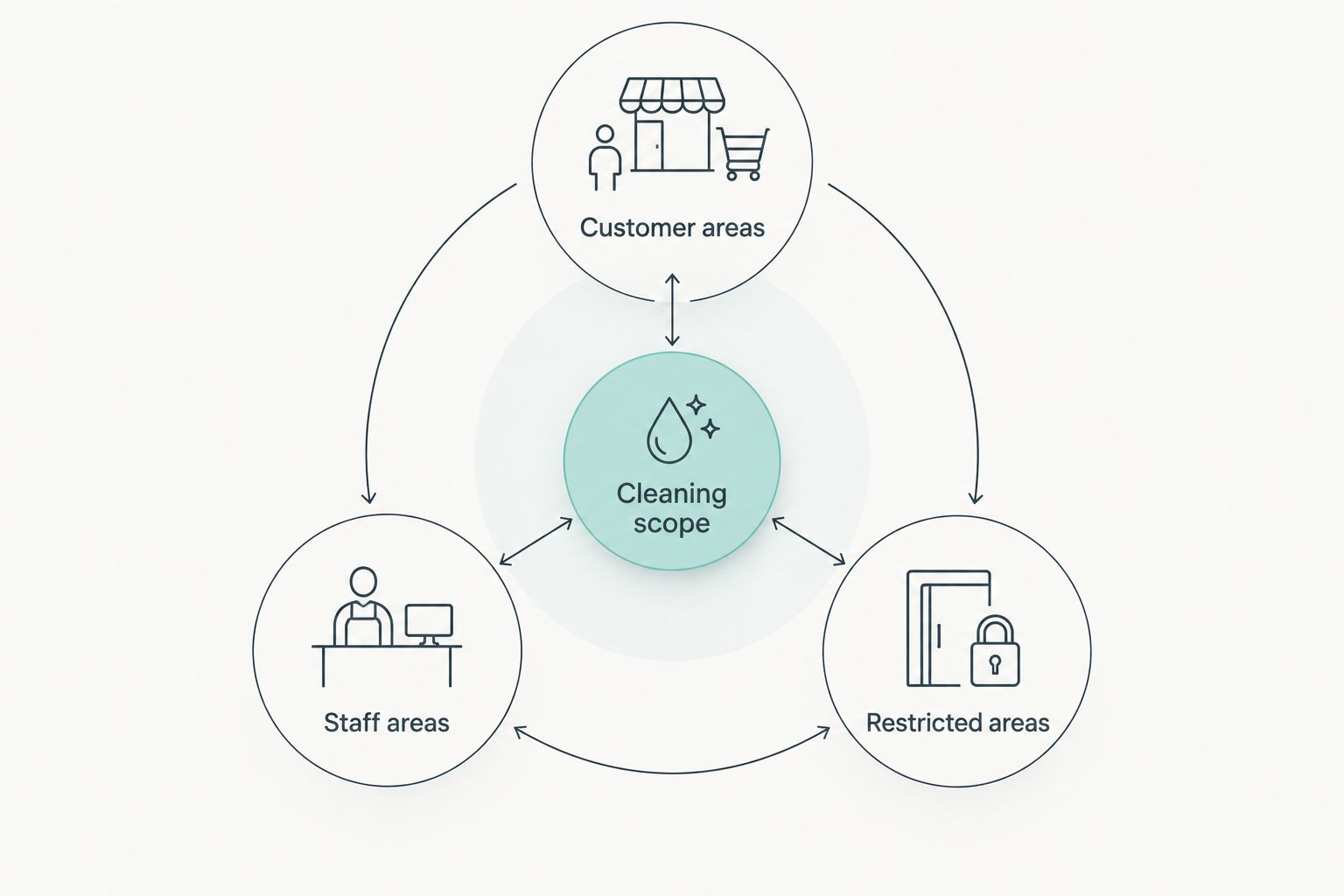
Start your 2026 brief with 3 store zones: customer areas, staff areas, and restricted areas. Then name the tasks and boundaries within each zone. That gives every candidate the same job to assess.
Customer areas
List entrances, sales floors, fitting rooms, mirrors, checkout counters, and customer restrooms where applicable. State whether cleaners should work around merchandise or whether employees will clear designated surfaces beforehand.
Do not write only “clean displays.” Specify whether that means the exposed shelf surface, surrounding floor, or display glass—and identify anything cleaners must not touch.
Staff areas
Include the break area, staff restroom, office, and agreed stockroom routes. Identify waste collection points and decide who supplies replacement liners, paper products, and soap.
Keep cleaning tasks separate from inventory handling. Moving stock, unpacking deliveries, and reorganizing shelves should not become accidental cleaning responsibilities.
Restricted areas
Name cash-handling spaces, locked cabinets, alarm equipment, and any rooms excluded from service. Give access instructions only to the people authorized to receive them.
The building access guide for office cleaning provides a related starting point for organizing access questions. Your store’s actual permissions must still be agreed directly with the provider.
Use a walkthrough to settle the details
A useful selection process includes 2 walkthroughs: a scoping walkthrough before agreement and a completion walkthrough after the initial service. These are recommended checkpoints, not a claim about any provider’s standard process.
During the scoping walkthrough, show the cleaner the actual surfaces and problem areas. Explain delivery activity, customer routes, and anything that must stay untouched.
During the completion walkthrough, compare the work with 1 written checklist. Record specific gaps by location and task, rather than saying the store needs to look cleaner.
Before signing your 2026 agreement, settle these points:
- Timing: Agree when work begins, when access ends, and who checks the premises afterward.
- Supplies: Identify who brings equipment and cleaning products, and who replaces consumables.
- Merchandise: Define whether anything can be moved and who approves exceptions.
- Safety: Agree how wet areas, spills, and unexpected hazards are reported and managed.
- Changes: Specify how you request additional work or revise the regular checklist.
- Corrections: Name the contact for missed tasks and agree on the response process.
For cleaning chemicals, follow product labels and the relevant surface-care instructions. Cleaning and disinfecting are not interchangeable tasks; if you request disinfection, identify the surfaces and instructions that apply.
How the options were ranked
The order prioritizes a confirmed local commercial service, then increasingly specific or supplementary approaches. The criteria are service-area fit, documented scope, surface suitability, security, insurance and screening, and issue handling.
No comparative testing, customer-review ranking, or competitor performance score is claimed. Choose by documented fit, not by the position of an option in a list.
Which retail cleaning option should you choose?
Start with a local commercial provider when you need general store cleaning. Add a floor-care specialist only when the task requires one, and keep employee touch-ups focused on what happens between visits.
For an undecided retailer in North or Central NJ, the next move is simple: prepare the store checklist and ask whether the provider can meet it. A clear exclusion is more useful than a vague promise.
Discuss your store’s cleaning needs
Share your location, store areas, surface requirements, and access instructions.
FAQ
What’s the best commercial cleaning service for a retail store in NJ?
The best fit is a provider that confirms your store’s location, tasks, surfaces, and access requirements in writing. Bestmaidsever is a relevant starting point in North and Central NJ because it explicitly offers insured, background-checked commercial cleaning.
Can a regular commercial cleaner handle a retail store?
A commercial cleaner is a suitable candidate only when the provider confirms your retail scope. Ask specifically about fitting rooms, displays, stockroom boundaries, checkout areas, and merchandise handling.
Should retail cleaning happen before opening or after closing?
Choose the cleaning window around customer access, staff supervision, and the work involved. Confirm the timing directly with the provider rather than assuming evening or early-morning service is included.
Does retail store cleaning include floor stripping or carpet extraction?
Include floor stripping or carpet extraction only when the written agreement explicitly names that work. Routine floor cleaning does not establish that a provider offers specialist treatments.
Do commercial cleaners bring equipment and supplies?
Equipment and supply responsibilities must be confirmed with the provider. Separate cleaning tools and products from restroom consumables so neither side assumes the other is supplying them.
Is eco-friendly cleaning suitable for a retail store?
Evaluate eco-friendly cleaning against the store’s surfaces and required tasks. Ask which products and methods the provider proposes, and do not treat an eco-friendly description as proof of disinfection or universal surface compatibility.
What should I check after the first retail cleaning visit?
Check the completed work against the written scope, room by room. Report any missed task with its location, and agree on how it will be corrected before changing the ongoing plan.
One last thing
Put “do not touch” instructions beside the cleaning tasks, not in a separate message that gets forgotten. A cleaner needs to know both what to clean and what to leave alone—especially around merchandise, electronics, and locked storage.
For your 2026 store plan, that boundary belongs on the same checklist as floors, mirrors, and bins. Keeping it simple works best when simple is also specific.