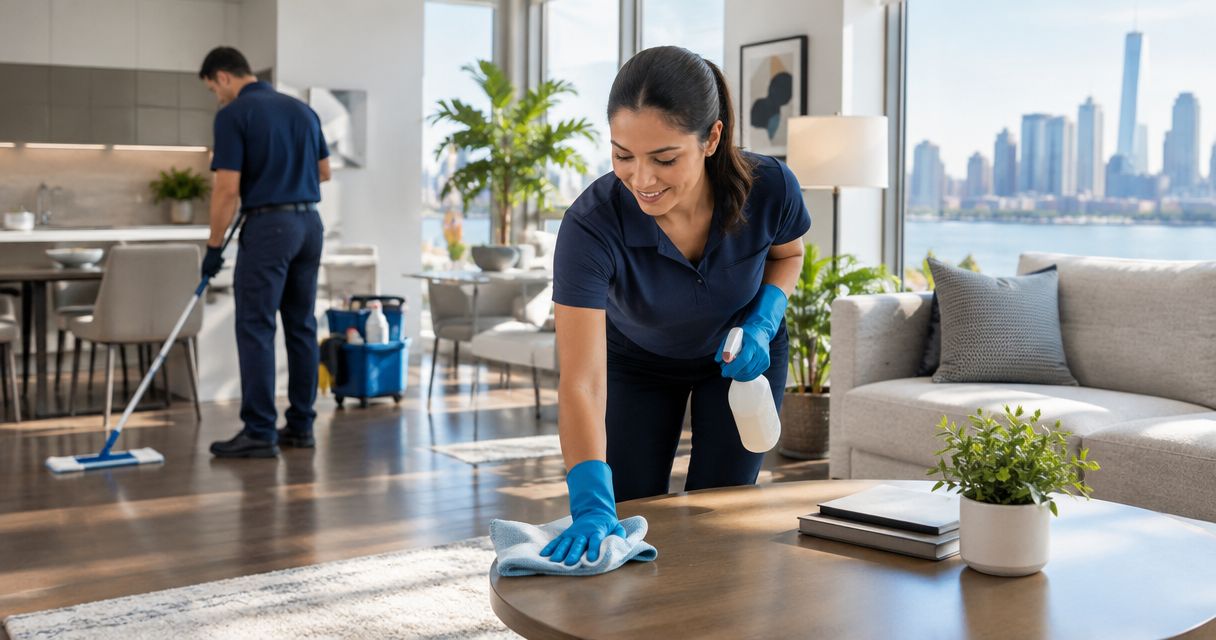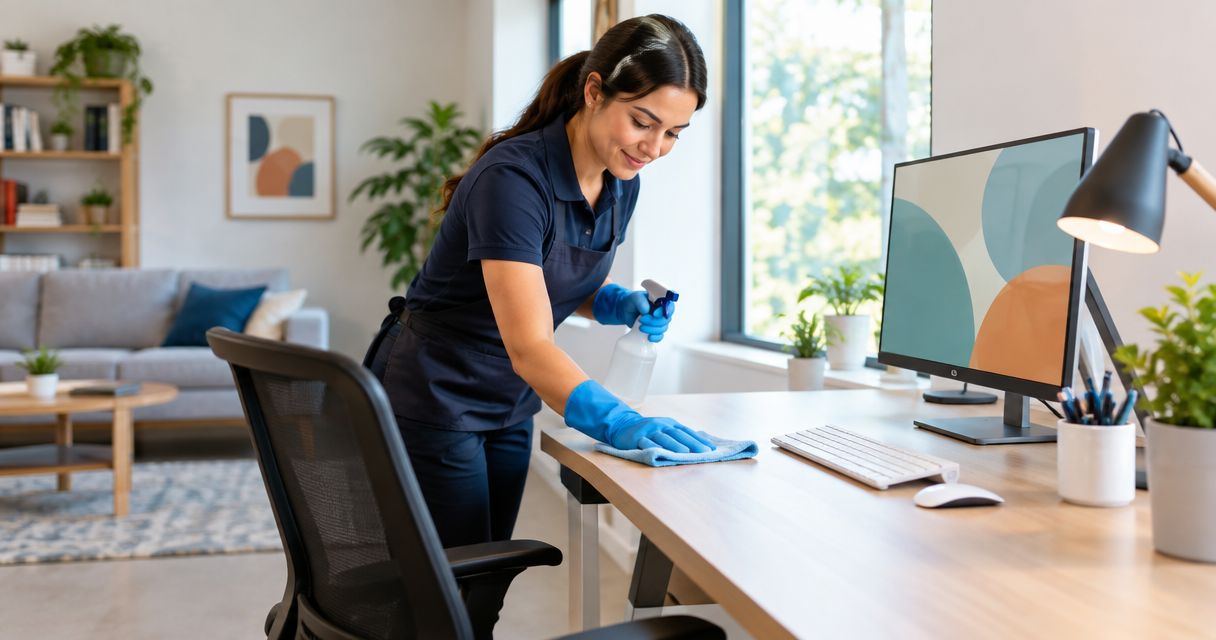
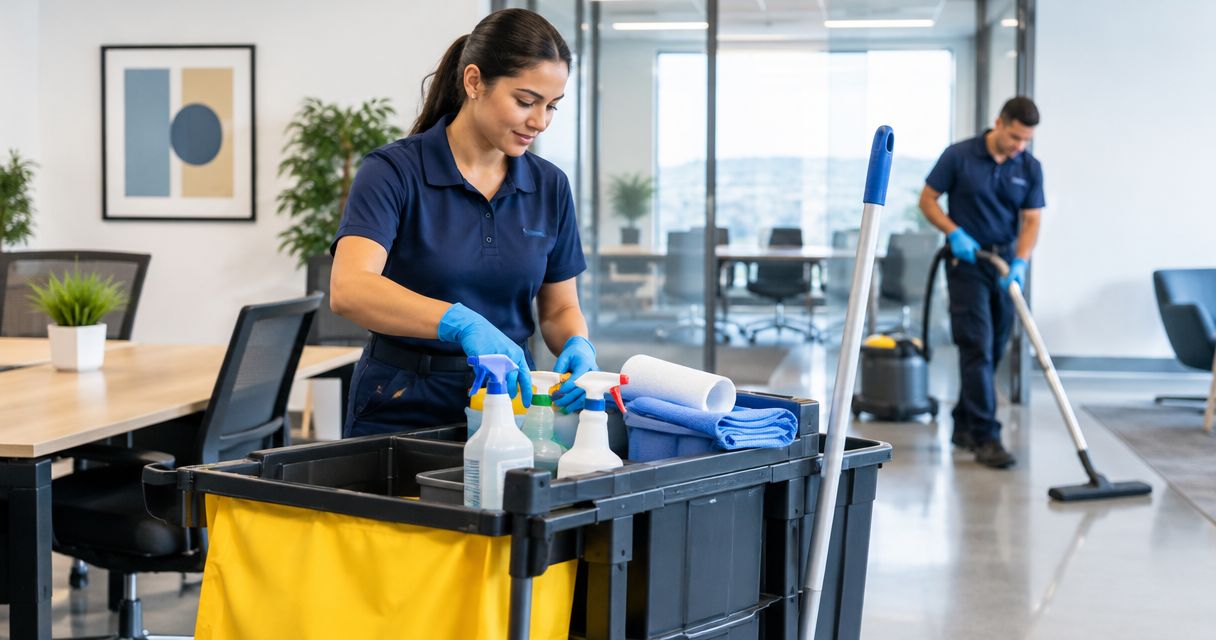
Commercial cleaners can bring their own equipment and supplies, but you should not assume every item is included. Your service agreement should identify who provides cleaning tools, cleaning products, and items your staff uses, such as soap and paper towels. Confirm those responsibilities before the first visit, especially if your building requires particular products or equipment.
- Commercial cleaning supply arrangements belong in writing: confirm equipment, cleaning products, and restroom refills separately.
- Provider-supplied equipment reduces your purchasing tasks; business-supplied products give you control but require inventory management.
- Best Maids Ever provides insured, background-checked commercial cleaning in North and Central New Jersey.
Why this matters
A cleaner arriving with a vacuum does not tell you who replaces an empty soap cartridge. Equipment, cleaning chemicals, and everyday consumables are different responsibilities. Leaving them under a vague promise to provide supplies creates an avoidable gap.
If you are comparing office cleaning services in New Jersey, ask each provider the same supply questions. For a 2026 service agreement, a written responsibility list is more useful than a general assurance that everything is handled.
Do commercial cleaners bring their own equipment and supplies?
Commercial cleaners bring equipment and supplies when the agreed service includes them. Other arrangements use materials you provide or divide responsibility between your business and the cleaner. The deciding document is your cleaning scope, not the job title of the person carrying the mop.
These arrangements solve different problems. Choose the one that matches how much purchasing, storage, and product oversight you want to keep.
| Arrangement | Best for | Main advantage | Main drawback | Confirm before booking |
|---|---|---|---|---|
| Provider-supplied | Businesses that want fewer cleaning purchases to manage | The provider handles the agreed tools and products | Your preferred products are not automatically included | Exact inclusions, substitutions, and equipment needs |
| Business-supplied | Businesses that require selected products or dedicated equipment | You control what is available on-site | You manage purchasing, storage, and replacement | Whether the cleaner accepts your products and tools |
| Shared supplies | Businesses that want selected items kept on-site | Responsibility can match individual building needs | Unclear boundaries leave supplies unassigned | A named owner for every item category |
None of these arrangements guarantees that restroom refills, specialist machinery, or every requested task is included. Put those items on the list individually. A short, specific agreement beats a long conversation nobody remembers the same way.
Provider-supplied: best for less purchasing administration
Under a provider-supplied arrangement, your cleaner brings the equipment and products identified in the agreement. Ask for categories rather than accepting a broad statement about supplies: floor-cleaning tools, surface-cleaning products, restroom-cleaning materials, and waste-handling supplies all deserve a clear answer.
The advantage is fewer cleaning purchases for your team to coordinate. The trade-off is that you must communicate restrictions before the cleaner selects products or equipment.
Confirm whether equipment travels with the crew or stays at your property. Those arrangements create different access and storage needs, even when the provider owns everything.
For your 2026 cleaning checklist, record exceptions beside the included items. If a particular floor needs a specified method, note that requirement rather than assuming the cleaner's standard kit covers it.
Business-supplied: best for direct product control
Under a business-supplied arrangement, you provide the agreed materials. This gives you control over product selection and lets you keep designated equipment at the property, but it also gives you responsibility for making those items available.
Get the cleaner's agreement before buying products for the job. A bottle being available does not establish that it suits the surface, the task, or the cleaner's working procedures.
Keep products in their labeled containers and provide the instructions needed for their intended use. If you require a particular product, identify its intended surface and location rather than leaving the cleaner to guess.
Also agree on what happens when something runs out or stops working. Decide who receives the report, who replaces the item, and whether the affected task waits. Otherwise, your team and the cleaner can each reasonably expect the other to handle it.
Shared supplies: best for clearly divided responsibilities
A shared arrangement assigns some items to the provider and others to your business. For example, your agreement could assign cleaning tools to the cleaner while your team supplies dispenser-compatible soap and paper products. That is a proposed division to negotiate, not an automatic industry rule.
The benefit is flexibility. The drawback is the extra coordination needed to prevent gaps.
Use an item-by-item list instead of saying that your business handles miscellaneous supplies. Specify who supplies trash liners, who loads dispensers, and who orders replacements. Purchasing an item and installing it are separate tasks.
A shared arrangement works best when a named person on each side can resolve supply questions. An unlabeled cupboard and a message passed through several employees are not much of a system.
What should your equipment and supplies list include?
Separate your list into categories that describe what the items actually do. This makes the discussion easier and stops a promise about cleaning products from being mistaken for a promise about restroom inventory.
Cleaning equipment
List the tools required for the agreed work, such as vacuums, mops, buckets, brushes, and reusable cloths. These are examples to discuss, not a statement that every commercial cleaning service includes them.
Ask who maintains provider-owned equipment and who reports problems with business-owned equipment. If a task requires machinery beyond ordinary hand tools, identify that requirement before agreeing to the scope.
Cleaning products
Specify the types of products the work requires and any surface restrictions. General surface cleaning, glass cleaning, and disinfecting are not interchangeable instructions.
If disinfection is included, the product label controls its intended use, dilution where applicable, and required contact time. Do not substitute a guessed waiting period. Follow the actual label for the actual product.
Consumable refills
List hand soap, toilet tissue, paper towels, trash liners, and other items used up during building operations. Then separate ordering, delivery, storage, and refilling responsibilities.
A cleaner can be responsible for refilling a dispenser without being responsible for purchasing its contents. Confirm both sides of that sentence.
Site requirements
Document approved storage areas, available water access, electrical access where needed, and any restricted rooms. Note product restrictions and surfaces that require special care.
Your 2026 supply list should describe the building as it operates now. Update it when dispensers, flooring, access arrangements, or room uses change.
Why equipment and supply arrangements vary
The right arrangement depends on the work and the property. Use these factors to shape the agreement rather than assuming that another business's setup will fit yours:
- Service scope: Routine surface cleaning and a task requiring specialist equipment need different equipment discussions.
- Surface requirements: Flooring, finishes, and fixtures determine which products and methods are appropriate.
- Product restrictions: Fragrance preferences, approved-product lists, and other stated restrictions affect product selection.
- Storage arrangements: Keeping equipment on-site requires an agreed location and access rules.
- Consumable compatibility: Soap cartridges, paper products, and liners must fit the equipment or containers you use.
- Purchasing responsibility: Someone must order replacements, monitor inventory, and respond when an item is unavailable.
Avoid solving these questions with a blanket request to bring everything. A better instruction names the task, identifies the requirement, and assigns responsibility.
How do I confirm supplies before the first cleaning?
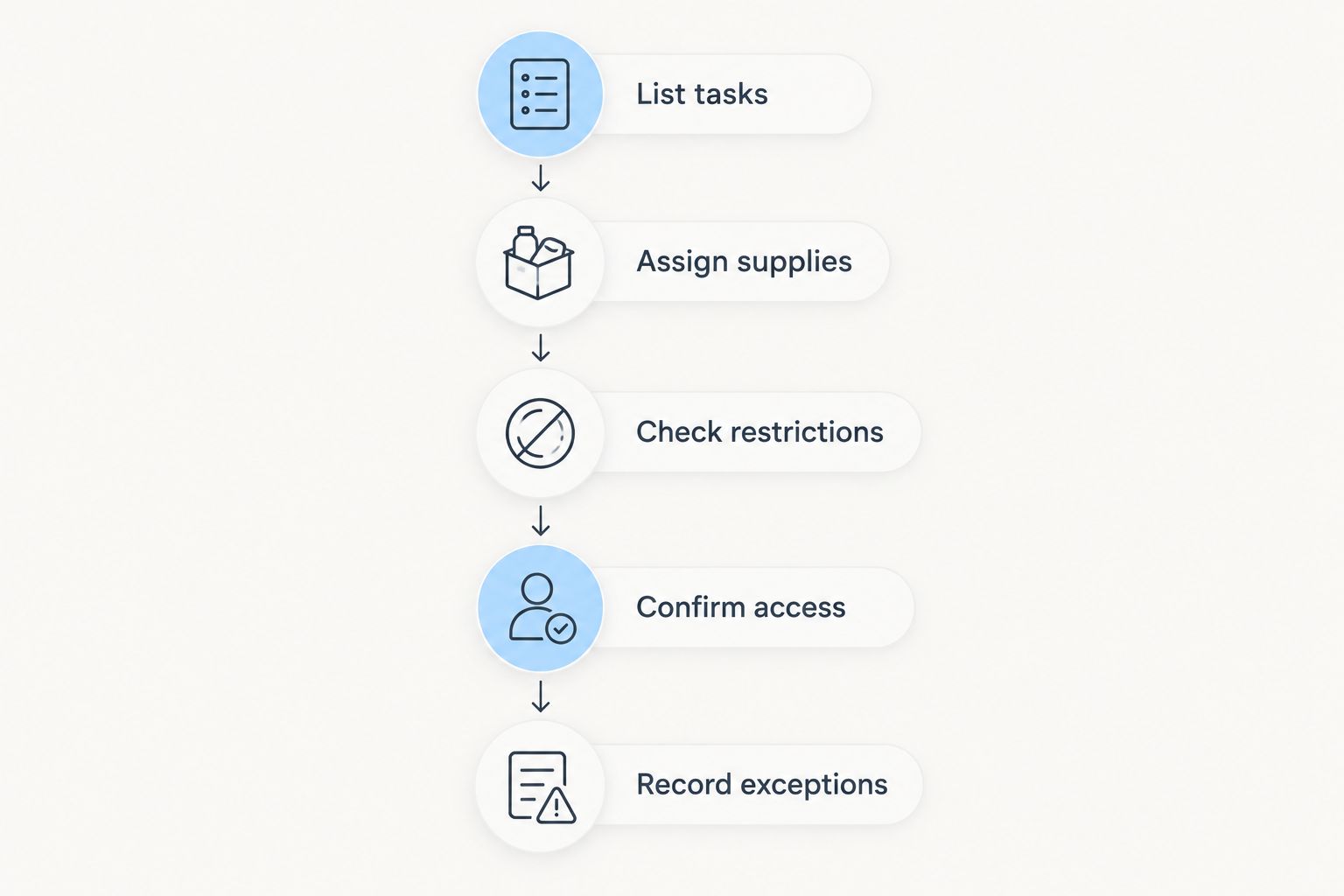
Use this sequence when setting up commercial cleaning in 2026. It turns a broad question into a workable handoff without making your office manager become a cleaning-equipment expert.
- List tasks. Identify the rooms and work included in the visit. Keep special requests separate from routine duties.
- Assign supplies. Mark who provides tools, cleaning products, liners, and dispenser refills. Leave no category assigned to everyone.
- Check restrictions. Share surface-care instructions, product restrictions, and any approved-product requirements before work begins.
- Confirm access. Agree on storage, keys or access permissions, and how the cleaner reaches any supplies kept on-site.
- Record exceptions. Write down excluded tasks, substitutions needing approval, and the contact for missing or unsuitable materials.
The finished checklist should let either side answer the same question without another call: what arrives with the cleaner, what is waiting in the building, and what is outside the agreed work?
After the initial visit, compare the checklist with what the job required. Resolve unclear items in writing so the same question does not return at every cleaning.
Can I ask commercial cleaners to use my products?
You can request your own products, but get acceptance before the visit. Share the product name, intended surface, label instructions, and any reason a substitute is unacceptable.
Do not treat a preference as confirmation. Ask whether using your products changes the agreed process and who provides a replacement when your chosen item is unavailable.
Does bringing supplies mean every cleaning task is included?
No. Supplies and service scope are separate commitments. Bringing a tool does not automatically add a task to your agreement, and agreeing to a task does not identify who provides its materials.
Ask for both details together. For each special request, confirm the work, the required equipment, and the person responsible for supplying it.
Who replaces soap, paper towels, and trash liners?
The party named in your agreement replaces consumables. Specify purchasing and refilling separately, including who checks the remaining stock.
Use the exact dispenser or container requirements when ordering. An available refill is only useful if it fits where your staff needs it.
Choosing commercial cleaning in North and Central New Jersey
Best Maids Ever is best suited to North and Central New Jersey businesses seeking insured, background-checked commercial cleaning. The company also offers eco-friendly cleaning, but you should discuss your specific product requirements rather than assuming what that service includes.
When contacting Best Maids Ever, share your room list, surface restrictions, and preferred supply arrangement. Ask for confirmation of equipment, products, consumables, and exclusions before the first appointment.
The benefit is a local service option with the stated insurance and background checks. The limit is straightforward: those credentials do not establish which supplies are included in your particular job. Put the supply details in the agreement.
FAQ
Do commercial cleaners bring their own vacuum and mop?
Commercial cleaners bring vacuums and mops when those tools are included in the agreed service. Confirm the equipment list and whether anything must remain on-site before the first visit.
Do I need to buy cleaning supplies before office cleaners arrive?
Buy cleaning supplies only after you confirm which items your business must provide. Ask about tools, cleaning products, trash liners, and restroom refills separately.
Can I request fragrance-free cleaning products?
You can request fragrance-free products, but confirm that the cleaner accepts the requirement before booking. Specify whether substitutions need your approval.
Are paper towels and toilet paper included in commercial cleaning?
Paper towels and toilet paper are included only when your agreement assigns their supply to the cleaner. Purchasing them and refilling dispensers should be listed as separate responsibilities.
Does eco-friendly cleaning mean the cleaner brings every product?
An eco-friendly cleaning description does not establish who supplies every product. Confirm the products, surface requirements, and purchasing responsibilities directly.
What should I do if the cleaner arrives without a required supply?
Contact the person named in your agreement and confirm how the affected task will be handled. Record who will provide the missing item and whether the work needs to be rescheduled.
Does Best Maids Ever provide commercial cleaning in New Jersey?
Best Maids Ever provides insured, background-checked commercial cleaning services in North and Central New Jersey. Confirm the equipment and supply arrangement for your property before the first visit.
One last thing
An empty soap dispenser can reflect an ordering gap, a storage gap, or a refilling gap. Buying another bottle addresses only one of them.
Before signing your 2026 cleaning agreement, ask who checks stock and who acts on that check. Assigning the next action matters just as much as assigning the supplies. That is how you keep a simple cleaning arrangement simple.