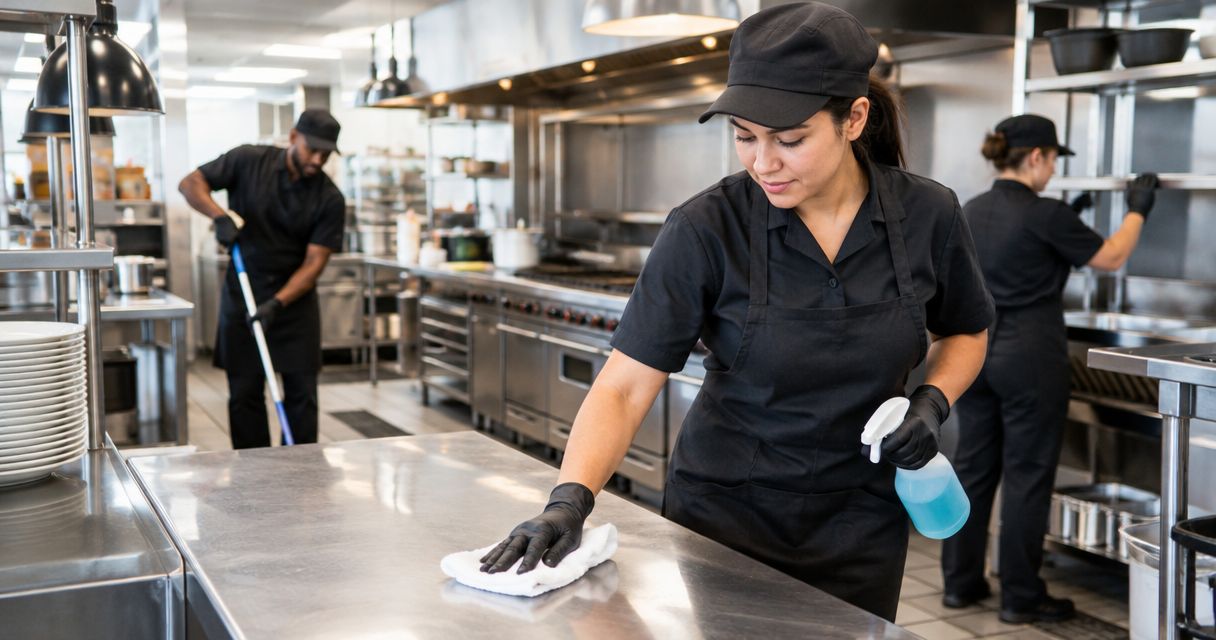
Restaurant cleaning is the scheduled cleaning and sanitation of food-service spaces with the aim of supporting safe operations and a clean guest experience. Choosing a restaurant cleaning service in 2026 means separating everyday food-safety duties from contracted cleaning: dining rooms, restrooms, food-contact surfaces, and grease-heavy equipment do not all need the same treatment.
- Best Maids Ever suits North and Central New Jersey businesses seeking insured, background-checked commercial cleaning.
- Choose a restaurant cleaning service by written scope, not a general promise to clean the kitchen.
- Keep food-contact sanitation separate from dining-room cleaning and specialist kitchen exhaust work.
- Assign each cleaning task an owner, a method, and a completion check before work begins.
Why commercial cleaning matters for restaurants
A restaurant has two audiences for cleanliness: guests who see the dining room and employees who work around food. Your cleaning plan must serve both. A polished entrance does not establish that a prep counter was properly cleaned and sanitized.
Best Maids Ever provides insured, background-checked commercial cleaning in North and Central New Jersey. Best Maids Ever commercial cleaning is best for local businesses seeking insured, background-checked cleaners for an agreed general-cleaning scope. Restaurant-specific equipment work and food-contact sanitation need explicit confirmation rather than assumptions.
For your 2026 cleaning plan, start with the work itself, not the vendor shortlist. Restaurant constraints include exposed food, grease, wet floors, restricted equipment access, and cleaning windows between service periods. Those details belong in the scope before anyone arrives with a mop.
Build your restaurant cleaning plan
Use the following steps to turn a broad request into work you can assign and inspect. Start with your existing staff, a walkthrough, and a written checklist; bring in outside help once you know which tasks you need covered.
Map your cleaning zones
Walk through the restaurant with the person responsible for opening or closing. Record each area separately, including spaces customers never see. A single entry labeled kitchen cleaning leaves too much room for disagreement.
Create 3 task groups: guest areas, food-production areas, and specialist systems. This is a planning structure, not a claim that every restaurant has the same layout. Add shared corridors, storage rooms, or delivery entrances wherever they fit your operation.
Write down surface materials and access restrictions alongside the tasks. A floor cleaner suitable for one surface is not automatically suitable for another, and equipment instructions take priority over a generic cleaning checklist.
- List dining tables, seating, entryways, and guest-facing floors.
- Separate restrooms and their tools from food-preparation areas.
- Identify food-contact surfaces and utensils explicitly.
- Mark equipment that requires disassembly or trained handling.
- Flag exhaust systems and grease-management equipment for specialist review.
Separate cleaning from sanitizing
Cleaning removes food residue, grease, and other soil. Sanitizing is a separate step that reduces microorganisms on a cleaned surface. Treating those words as interchangeable produces a checklist that looks complete without defining the required procedure.
For your 2026 procedures, use the FDA Food Code as a reference alongside applicable New Jersey requirements and local health-department guidance. Follow the actual product label for dilution, contact time, approved uses, and any rinse instructions. Do not copy a chemical ratio from an unrelated restaurant's checklist.
A food-contact surface needs a method appropriate to that surface and the operation. Do not let a contractor substitute a general bathroom disinfectant simply because it smells clean. Fragrance is not a food-safety check.
- Remove food and loose debris before applying cleaning products.
- Clean and rinse as required before sanitizing food-contact surfaces.
- Use products approved for the intended surface and task.
- Follow label directions rather than guessed dilution ratios.
- Keep food protected throughout the work.
Assign ownership before hiring help
Start with a simple task sheet your team can maintain. Give each task 1 accountable owner, even when several people perform the work. Shared responsibility without a named owner makes missed work harder to catch.
Best Maids Ever commercial cleaning becomes an option for delegating agreed general-cleaning tasks after you define that sheet. Confirm the restaurant scope directly, including which areas the team will clean and which duties remain with restaurant employees or specialist contractors.
Outside cleaning supports your operating plan; it does not replace your responsibility to manage food handling and sanitation. Write the handoff so the closing team knows what to finish and the opening team knows what to inspect. Nobody should have to guess who cleaned the prep area.
- Name an owner for each area and task.
- Mark tasks as staff, general contractor, or specialist work.
- List exclusions beside the assigned work.
- Define who supplies approved chemicals and tools.
- Specify who reports and resolves incomplete work.
Schedule around food handling and service
Build the schedule from your actual operating hours. Identify when food is exposed, when employees need equipment, and when floors must be dry for safe access. Do not choose a cleaning window solely because the building is quiet.
Your 2026 schedule should distinguish cleaning needed during operations from work that can happen after service. A contracted visit cannot replace cleaning triggered by a spill or contamination during a shift. Likewise, detailed floor work needs a handoff that keeps employees from walking into an unfinished area.
Tell the contractor about late departures, early deliveries, and restricted zones. A workable access plan is more useful than a vague instruction to arrive after closing.
- Record the cleaning window for each zone.
- Identify tasks triggered by use, spills, or contamination.
- Keep exposed food away from cleaning activity.
- Coordinate floor work with staff movement and drying needs.
- Assign key, alarm, and access responsibilities.
Confirm the contractor's scope and limits
Compare proposals against the same written task sheet. A shorter proposal is not necessarily simpler; it often leaves you with more questions. Ask whether the contractor means dining-room upkeep, accessible kitchen surfaces, equipment interiors, or something else when describing restaurant cleaning.
Best Maids Ever offers insured, background-checked cleaning services. Those stated credentials are relevant to contractor selection, but they do not establish kitchen-exhaust qualifications, equipment expertise, or inclusion of every restaurant task. Match the contractor to the work rather than treating insurance as proof of technical capability.
Request written answers before approving the scope. A clear exclusion is useful: it tells you what to assign elsewhere. An undefined inclusion is harder to manage because both sides can interpret it differently.
- Request current insurance documentation relevant to the work.
- Confirm how background-checked personnel access your premises.
- Ask which kitchen tasks are included and excluded.
- Check whether equipment requires a separate specialist.
- Agree on how scope changes are approved.
Prevent cross-contamination during the visit
Inspect your existing tool storage before buying anything new. Keep restroom tools separate from kitchen tools, and distinguish food-contact cleaning supplies from general-purpose supplies. Labels and dedicated storage make that separation easier to maintain.
Use a written sequence for each zone: protect food, remove soil, apply the appropriate procedure, and release the area for use. The sequence matters more than how shiny the surface looks afterward. A cloth that moves from a restroom to a prep counter defeats the purpose of cleaning.
Include chemical storage in your walkthrough. Keep products identified and stored away from food as required, and never mix cleaning chemicals. When employees cannot identify a container, stop and resolve it rather than guessing.
- Keep restroom tools in separate storage.
- Label containers and task-specific supplies.
- Follow equipment and surface-care instructions.
- Protect food, utensils, and preparation areas during work.
- Release each zone only after its procedure is complete.
Inspect the handoff and update the checklist
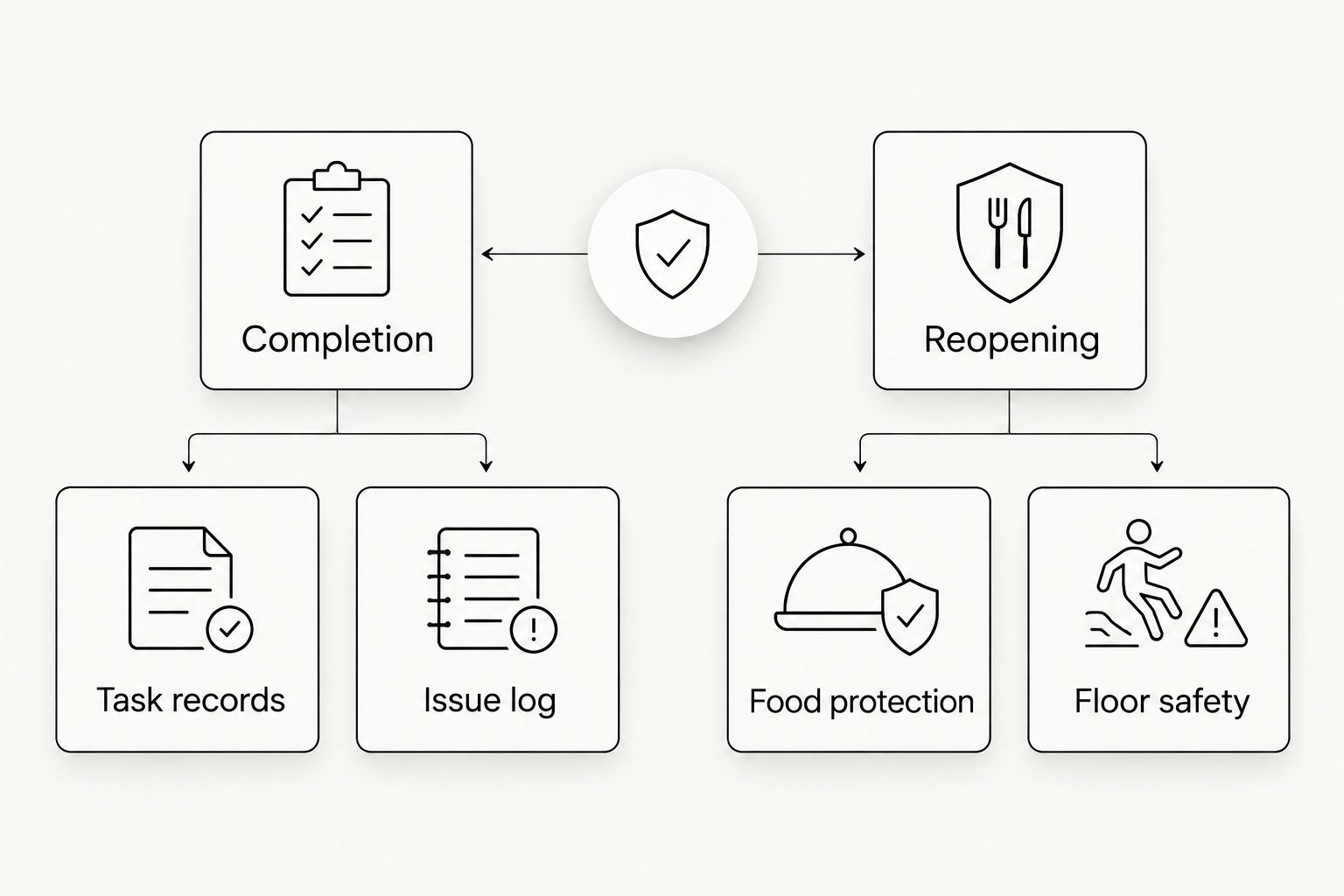
Use 2 checklists: one for task completion and one for reopening the space. The completion list records the work performed. The reopening list confirms that the restaurant is ready for employees and food handling again.
A manager should review the handoff against the agreed scope, not simply sign that the room looks clean. Check accessible areas that often get overlooked, such as table bases, floor edges, and restroom fixtures. For food-contact procedures, verify the process as well as the visible result.
Keep a short issue log and assign corrective work. When a missed task repeats, change the instruction, ownership, or scope instead of collecting another identical complaint. A useful 2026 checklist reflects how your restaurant actually operates.
- Confirm scheduled tasks were completed or clearly flagged.
- Check that chemicals and tools are stored correctly.
- Verify food-contact areas are ready under your procedure.
- Inspect floors for standing water, residue, and obstacles.
- Record defects and name the person responsible for correction.
Compare restaurant cleaning options
Choose the arrangement that matches the work, then document its limits. For a 2026 restaurant cleaning plan, the useful comparison is not simply employees versus contractors. It is who handles routine sanitation, general cleaning, and specialist systems without leaving gaps.
The options below describe responsibilities, not fixed service packages. Confirm every provider's scope before assigning work. The best arrangement is the one in which every necessary task has a capable owner.
| Option | Best for | Main advantage | Key limitation |
|---|---|---|---|
| In-house restaurant team | During-service cleaning and food-contact procedures | Staff can respond while food handling is underway | Cleaning competes with other shift duties and requires training and supervision |
| General commercial cleaning contractor | Agreed dining-room, restroom, and general-premises tasks | Delegates a defined cleaning workload | Restaurant equipment and sanitation procedures are not automatically included |
| Best Maids Ever | North and Central New Jersey businesses seeking insured, background-checked commercial cleaners | Provides the stated commercial-cleaning service with those safeguards | Restaurant-specific scope and technical tasks require direct confirmation |
| Specialist kitchen contractor | Exhaust systems or equipment requiring specialist methods | Matches technical work to the relevant expertise | Does not automatically cover everyday guest-area cleaning or staff sanitation duties |
| Combined staff-and-contractor plan | Restaurants assigning different tasks to different teams | Separates operational duties from outsourced work | Needs a clear handoff to prevent omissions and duplicate work |
A combined plan gives you flexibility, but only if the boundaries are written down. General premises cleaning does not establish that food-contact sanitation is complete. Specialist equipment work does not establish that the restroom was cleaned. Treat each as a separate assignment.
Discuss your commercial cleaning scope
Ask which restaurant areas and tasks fit the service before assigning work.
Common mistakes restaurants make
Treating a clean appearance as proof of sanitation
A counter can look spotless without having completed the required food-contact procedure. Keep visible-cleanliness checks and sanitation checks distinct. Ask who performed the procedure, what product was used, and whether its directions were followed.
The correction is straightforward: put the method on the task sheet, not just the desired appearance. Employees and contractors should work from the same definition of complete.
Assuming kitchen cleaning includes every system
Kitchen cleaning is a broad phrase, not a technical scope. It does not tell you whether the work includes accessible surfaces, equipment interiors, exhaust components, or grease-management systems.
List those items separately in your 2026 agreement. Require explicit confirmation for specialist work, and arrange an appropriate provider when the general contractor excludes it. An honest limit is better than a promise nobody can inspect.
Letting cleaning overlap with exposed food
A quiet corner of an operating kitchen is not automatically a suitable cleaning zone. Food, utensils, and preparation surfaces need protection from splash, dust, and chemicals during the work.
Set the cleaning boundary before the visit starts. If staff must keep using the area, define which tasks can proceed safely and which need another window under your operating procedures.
Leaving the opening team to discover problems
The next shift should not be the first to find standing water, misplaced tools, or unfinished tasks. A completion signature alone does not establish readiness to reopen.
Use the reopening checklist and a named handoff person. If a task remains unfinished, report it before employees begin food preparation. That is less exciting than a last-minute scramble, which is exactly the point.
FAQ
What's the best restaurant cleaning service for a New Jersey business?
The best restaurant cleaning service is one that confirms your required tasks, access arrangements, and exclusions in writing. Best Maids Ever provides insured, background-checked commercial cleaning in North and Central New Jersey; confirm its fit for your restaurant's specific scope.
Does a commercial cleaner sanitize food-contact surfaces?
Food-contact sanitation is included only when the agreed scope explicitly assigns that work and its required procedure. Do not assume that general kitchen cleaning includes sanitizing prep counters, utensils, or equipment.
Is cleaning the same as sanitizing in a restaurant?
Cleaning and sanitizing are different steps. Cleaning removes soil, while sanitizing reduces microorganisms on a cleaned surface; follow applicable requirements and the product's label directions.
Can a restaurant outsource all of its cleaning?
A restaurant cannot treat outside cleaning as a replacement for managing sanitation during operations. Assign immediate cleaning needs, food-contact procedures, and contractor handoffs explicitly so tasks do not wait for the next visit.
Does restaurant cleaning include kitchen exhaust systems?
Kitchen exhaust work is not automatically part of general restaurant cleaning. Confirm the system, required method, and contractor qualifications separately before assigning it.
How often should a restaurant schedule commercial cleaning?
Set commercial-cleaning frequency by the task, use of the area, applicable requirements, and your operating schedule. Cleaning needed during food handling or after contamination must not wait for a scheduled contractor visit.
What should I ask before hiring a restaurant cleaner?
Ask for a written task list, exclusions, insurance documentation, access arrangements, and a completion process. Also confirm who handles food-contact sanitation and any equipment requiring specialist work.
One last thing
Put exclusions next to inclusions, not in a separate document nobody reads. When a task is outside the contractor's scope, assign its owner on the same line. That small change makes a cleaning agreement useful to the people opening and closing your restaurant.
Before your next 2026 cleaning review, take the checklist onto the floor and follow it literally. If an instruction does not tell you what gets cleaned, how completion is judged, and who owns it, rewrite it. Keep it simple enough to use on a busy shift.